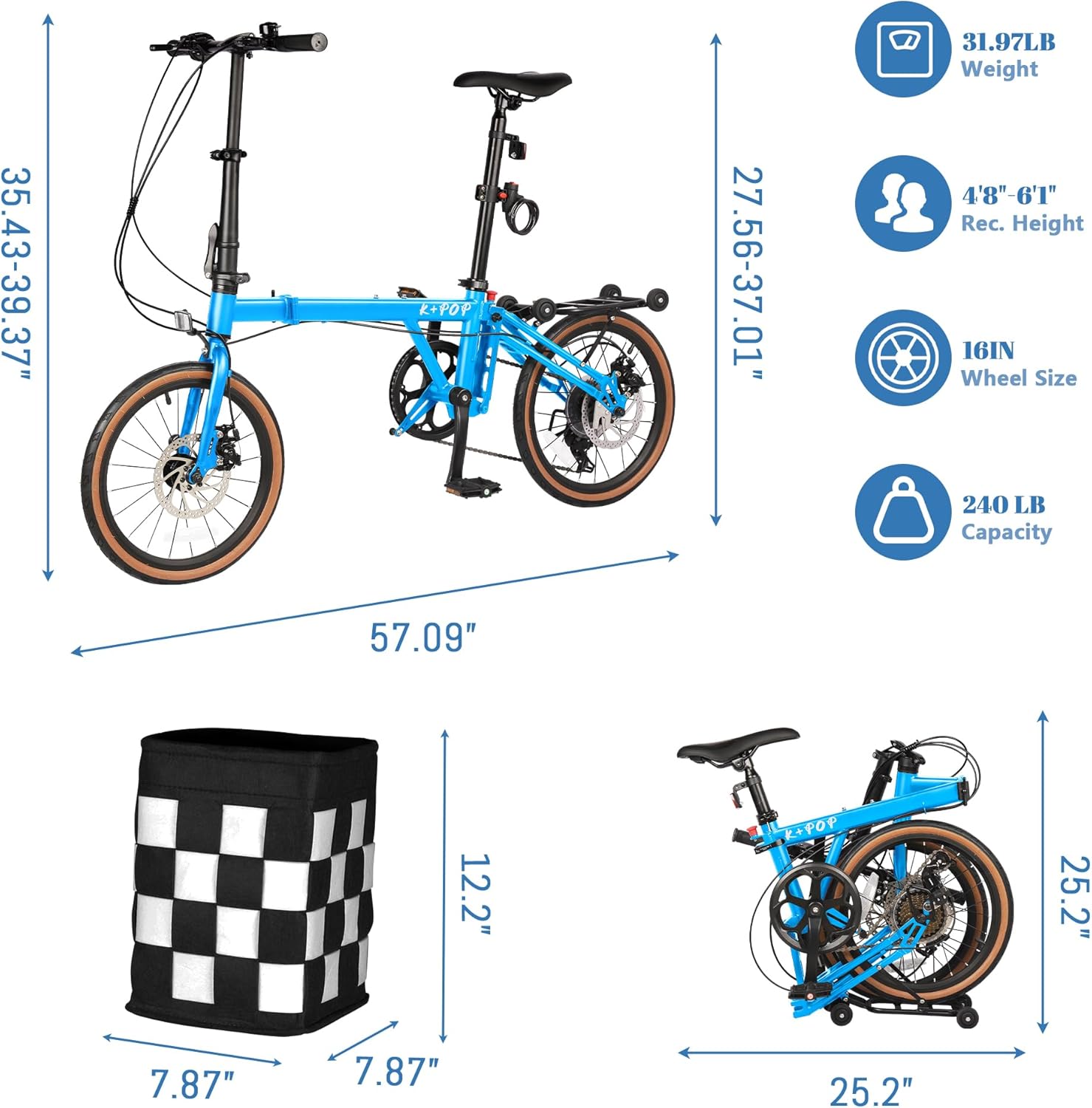
K+POP 16″ Trifold Bike

The K+POP trifold is derivative of a Brompton, but not actually a Brompton clone. At only ~$200 it is a downmarket model that has a less optimized fold and some cost savings, but is surprisingly functional. It’s made mostly from steel and the 32lb quoted weight is accurate. As far as I know, this is one of the first trifolds that isn’t a close Brompton clone, so I assume the innovations are in fact, innovative, although that could be inaccurate.

The frame is less optimized than the Brompton, lacking the curved main tube. When folded, it wasn’t actually much shorter than a 16″ bifold, but it would likely be if it were more vertical with the rear rack removed. Unlike the Brompton, there is no rear suspension, just a safety pin and a QR skewer. The safety pin does not have to be pulled to unfold the bike, and it strong enough to lift the bike when folding it, making it relatively quick and painless and slightly easier than the Brompton latch. The QR skewer did need to be unscrewed a few turns each time however, making the fold here a bit slower. It does have bottle cage bosses on top of the main tube though, which is nice.

The rear “triangle” lacks chainstays. This wouldn’t be useful for a belt drive due to chainstay length effectively shortening while folded. While on a bifold bike it would be less of an issue, it seems questionable on a trifold bike. However, this modification to the design is not for looks, but rather a way to cut costs and make it compatible with a standard derailer. No chainstay makes it easier to design the fold since chainstay clearance is no longer a concern. It also allows the chain hanger to pick up the chain when folded, but be out of the way when unfolded, as opposed to the Brompton’s chain tensioner, or special derailers requiring special chain tensioners. That being said, the rear end is reasonably stiff for this kind of bike, I’ve ridden folders that were stiffer, and vintage folders that were flexier.

The version I received uses an auxiliary dropout and a spool that drops in as opposed to the Brompton’s fork hook, and the K+POP design seems more durable, less obtrusive, and none of the moving parts touches the paint. There is however, no handlebar catch, so without being strapped down, it could flop around.

The stem uses a tooless lever with a safety catch, making this operation easier than the Brompton. It is also QR height adjustable, clearly marked for height in cm, and has an anti-rotation groove. The stem also has a QR handlebar clamp, but this is not terribly useful on flat bars unless you need every inch of space. Functionally, it seems superior in most ways other than optimizing fold size. The lower tube is made from steel and the inside tube is made from aluminum, and it attached using a 25.4mm quill (for 1-1/8 threaded steerers).

The seatpost locks the frame like a modern Brompton, making it easy to lift. It’s a simple steel seatpost with “guts” as a saddle rail clamp, but it seems to function. Weight could probably be reduced for swapping it, but it’s unlikely you can make it as light as a Brompton.

The wheels on the rack roll smoothly and are functional. My rack was not the full tubular version, but still felt stiff when all the bolts were tightened. The rear rollers were prone to bending, but using a threaded rod that passed though both as an axle increased the strength. With the front roller extended, it felt reasonably stable and rolled easily.

The shifting is handled by a sub-Tourney non-slant Shimano unit, but it shifts the basic 7 speed freewheel fine. The derailer hanger is integral to the frame and straight, unlike more finicky claw hanger models. It also has a derailer guard, which adds to the folded size, but useful to prevent the hanger from getting tweaked. It’s very functional, I was going to swap out the derailer, but realized I don’t need to until this one wears down.

The headset is a difficult to adjust threaded headset, which requires a large pin wrench and faith in the toothed washer to adjust. The bearings are in a retainer ring, making it easy to grease. There was some grease, but it could use more. Mine also required adjustment out of the box.

The breaks are surprisingly powerful, likely due to the small wheelsize and mechanical advantage offered. This has nothing to do with the quality of the brake, as they are basic mechanical calipers that would be scorned on any full size bike. This was another part I had an upgrade replacement ready on hand, but I think the brakes may actually be too powerful, so I might swap the brake levers to Vs.

The cranks are basic square taper cranks with a swaged steel chainring. The guard helps a little on a commuter bike, and a full chainguard (hockey stick) or chaincase wouldn’t really work on a trifold. The bottom bracket is surprisingly a cartridge unit, which is nice and requires no maintenance or adjustment.

The hubs also had big rubber seal cartridge bearings and required no adjustment, a pleasant surprise on a bike at this price point. The axle nuts were done extremely tight, and the caps has to be pried off with a small flathead, something to keep in mind for flat changes. It also required a brake adjustment after reseating the wheels. The front needs the tabbed washers as the dropouts point down rather than forward, and the disc brakes could eject the wheel. The front should be done up very tight. The tires are some kind of Innova skinwall, with maybe a 30 TPI casing. They rolled decently well, much better than tires with thick rubber sidewalls. There is no clearance for larger tires or fenders. Annoyingly, the front came laced radially, which is not appropriate for disc brakes, and I have to determine if it is worth it to relace the wheel.

All in all, it’s a surprisingly nice little folder for the price point, and seems like it would make a great beater/commuter. It’s actually fine and doesn’t feel like complete junk, but it’s obviously not a Brompton. My biggest gripe is the radially laced front wheel, and relacing the wheel is a major job for those not experienced.

Mods:

Relaced front wheel to semi-radial/2x. I used 10x 157mm spokes on the disc side, 155-157mm is probably fine. Cost me about $7 online and it wasn’t worth the effort of cutting and threading spokes at the shop. This noticeably reduced torsional flex of the rotor, and brake juddering. This thing can easily do stoppies.

Roller wheel axle. Used a 1/4″ threaded rod and some nuts to make a solid rear axle for the rack mounted wheels so the tabs they are mounted to don’t bend. Maybe $3 worth of hardware I already had.

Cut the seatpost. The bottom of the seatpost has a taper and a second 7/8″ neck, since the long seatpost is basically just 2 seatposts back-to-back. The taper serves a purpose to guide the seatpost into the frame lock, but the 7/8″ neck does nothing, it doesn’t allow the seatpost to go any higher, but cutting it off will let the seatpost go lower when folded. Free.

Aluminum handlebar. The original handlebar is steel, and aluminum makes it marginally lighter. From the parts bin.

Bottle cage. Unlike other folders, this one has a bottle cage mount. Nice.

Conventional 1 1/8″ headset locknut and keyed washer. The stock one prevents easy adjustments and there was an issue where moving the stem back and forth would also shift the stock locknut and cone because of the contact over the large radius.

Freehub hub. This takes a lot of work, and 135mm rear on a folder is usually seen as a disadvantage due to excessive width, but the standard width lets me put a standard hub in, which lets me get more and higher gears. Might as well take advantage of the full size OLD to run extra gears. I think bikes like Mint have reduced OLD and have a standard 8-10s freehub. Hub was about $40 plus the time to rebuild the wheel.

11-speed gearing. The stock freewheel is 14-28 (not even 13-28), so an 11-28 cassette gives 3 more gears on the top end, which is appreciated. Even 13-28 is an improvement due to the small 16″ wheels. The frame doesn’t have much room for the chain run of a larger chainring, so this is the way to get higher and more gears. the 48T chainring on 16″ is about equal to a 30T chainring on 700c. Double not cheap. I made mine work with an XT shifter (Dynasys), but the Micronew 11 speed shifter works with old Shimano cable pull so it is easy to find an old decent short cage derailer. I would have gone 12, but I had some 11 stuff lying around since the MTB got upgraded from 11 to 12, and I didn’t really need 12, since it’s mostly for the top end.

Cranks. The original cranks are swaged and the Q-factor is kind of high, had some lying around.

Folding pedals. Really only needed on the right side, but Brompton pedals have a left-only folding pedal, so I had to buy a pair. About $20.

If you’re buying the bike with the intention to upgrade, you might just look at a Mint ($500+) though. I got this bike for cheap, and had a lot of parts already.

Shimano CUES is Anti-Consumer

Recent leaks of the CUES STIs has me thinking about CUES again.

When CUES was first announced lot of cycling talking heads were talking about how CUES is great for the consumer due to parts compatibility. I think some have soured a bit on it, but back then I thought CUES was a bad product, anti-consumer, and predatory.

I personally think linkglide is a great product, so I have no issue with 11-speed CUES. The issue is with 8-10 speed CUES (assuming Claris replacement is true, replace 8 with 9 if 8 is going away, ESSA seems to indicate that 8 speed will remain a thing though). The basic problem is that Shimano is selling an 11-speed groupset, minus some cogs and clicks. Costs of chains are the same. Their durability is the same. The precision required for shifting is the same. The cassette options are extremely limited to merely removing the biggest cogs. You might be thinking this is great if you don’t need the bigger cogs. However, the truth is, the cost difference between a base level CUES 8-speed and 11-speed should be less than $10 retail. In terms of wholesale/manufacturing cost, the difference in cost between a shifter of the same quality would be less than $0.01 (yes, one cent), because it requires a change in the stamping dies for the indexing ratchet, amortized over many many thousands of units. The cost of adding simple stamped steel cogs is approximately $1, maybe $2, based on cassette prices. Add in some mark-ups and you could have gotten an 11-speed bike for $10 more than 8-speed.

The supposed advantages of CUES is that it uses the same cable pull and chain in the same ecosystem, making it easier to find replacement parts, upgrade and make frankenbike systems.

  1. Replacement parts compatibility – Realistically, the only part that will be100% easier to find is the chain, because it’s an 11-speed chain, which will cost as much for 8-speed CUES as it does for 11-speed CUES. It makes it easier for bike shops to stock chains, but most mechanics know that a narrower (higher speed chain) will perform admirably on a lower speed groupset, especially on 1x which many CUES groups are. And, well, you’re basically using an 11-speed chain because your 9-speed CUES should have been 11-speed in the first place.

    Most bike shops will still stock 8-speed chains to service entry level 7-8 speed bikes though (and I’ve found 8 speed to shift quite solidly as the cogs are not spaced too closely there is little trickery to make 8-speed chains narrower).

    Technically you could use a different speed CUES cassette or shifter in a pinch for an emergency repair, and this has some small utility, except for the issue that your 9-speed CUES should have been 11-speed in the first place.

    Having a common actuation ratio for RDs is nice, but there exists more compatibility that many people know. CUES makes that compatibility simpler. You still run into the problems of needing to pick a 1x or 2x and the fact that derailers are designed for the capacity of the specific cassettes. Common actuation ratios also used to be common. There is also the issue that this shouldn’t matter because your 9-speed CUES should have been 11-speed in the first place.

    Really though, you’re just buying 11-speed parts, with artificially downgraded 8/9/10 speed variants that are just missing parts. You can use whatever combination of parts, but you’re going to be limited to the number speeds of the more artificially downgraded part. The truth is, stocking and sourcing these variants would be no easier than just having CUES as 11-speed only, which would have been the case if your 9-speed CUES was 11-speed in the first place.
  2. Upgradability – The only reason it is easy to “upgrade” CUES is because the lower-end parts have been artificially downgraded. They could have sold you a pre-upgraded low end CUES for $10 more retail, if it weren’t for pesky anti-consumer practices like market segmentation, price discrimination and artificially creating a product hierarchy. Having different speed variants lets Shimano and manufacturers peg prices to marketing and perceived value rather than actual manufacturing costs.

    So you can upgrade your 8-speed to 11-speed. You’ve saved on having to buy a new chain maybe, even though you should replace the chain with the cassette? Now you’ve bought a second shifter, which costs money, more money than if it came with the bike, and created an 8-speed shifter going to the landfill, over an artificially downgraded part, and you know it wasn’t to save $0.01 of manufacturing costs when stocking multiple SKUs would add to the overhead. And you wouldn’t have had to upgrade this if your 9-speed CUES had 11 clicks in the first place.

    You might think you could reuse your 9-speed CUES derailer because it has the same actuation ratio, but you’d be forgetting that the cage length, and therefore total chain wrap capacity, differs. The lower speed CUES are designed not to have enough chain wrap for the cassettes with more, and bigger, cogs, which mind you, must be linkglide, not standard hyperglide, so you don’t really have any options in terms of picking a suitable cassette. Another point of artificial incompatibility, and something you wouldn’t have to replace if the cage on 9-speed CUES was just a bit longer to deal with the 11-speed cassettes in the first place.

    The only reason was to make it so it would cost money to upgrade your bike instead of it basically being free and justify more expensive bikes being more expensive. If it were genuinely about upgradability, CUES would only come with 11-speed shifters and longish cages, just with slightly lighter/cheaper cassettes for bikes that really didn’t need 50t cassettes. You wouldn’t even need to create landfill waste and waste money if your 9-speed CUES was 11-speed in the first place.
  3. Frankenbike mixed groupsets – CUES flat bar and road share parts which lets you mix and match, except, the problem is there really aren’t many options to mix and match from. Compatibility it better, yes, but it basically comes down to, you can have any gearing, as long as it’s one of the very few CUES cassettes, and most of those cassettes are just 11-speed cassettes missing cogs. You can swap flat bar and drop bar parts more easily, but it doesn’t seem like it will actually get you a wide variety of options, just limited CUES options. There’s a bigger 1x only cassette, and there’s a smaller 2x compatible cassette (and the downgraded missing cogs versions of each)

So lets be clear, CUES is a good product, it solves some problems, but some of those problems are only solved because it artificially creates problems. Some problems only exist to facilitate predatory marketing strategies. The 11-speed variant is the right product for some niches. From a technical and manufacturing perspective, there’s no reason Shimano (and OEM customers) couldn’t have just phased out 9 and 10 speed and replaced them with 11-speed CUES. There’s no engineering or economic utility reason for 9 and 10 speed CUES to exist.

The shifters would be 11 speed if only for a few clicks that cost basically nothing to add. The cassettes would be 11 speed if they had the couple extra big cogs that would cost a dollar to add in basic steel. The derailers would be 11 speed if they had enough chain wrap to run the bigger 11 speed linkglide-only cassettes. The chain is 11 speed, except when held back by the other 9-speed parts which are 9-speed for no good reason. Cranksets don’t have to match in the first place, and doubly so for brakes which aren’t part of the drivetrain. There is no value added for 9/10 speed CUES equipped bikes. They’re just 11 speed groupsets that have had speeds 9 and 10 disabled, and artificial incompatibility to force you to upgrade multiple parts, despite the limited compatibility.

The 10-speed groupsets are actually pointless, because other than the shifter and cassette, they use the same parts other than the shifter and cassette. The actual in-store retail cost difference is $5 (production cost difference is about a cent). While it’s a rip-off, the only reason to downspec is to make it costly and wasteful to upgrade from 10 to 11 and avoid the costly Shimano 11 speed cassette. The 11-speed cassette is much much more expensive than it has to be, but that’s because there’s a XT linkglide group, and Shimano doesn’t want anyone to get the idea that they could buy affordable cassettes for XT level drivetrains when the competition is selling EAGLE cassettes for even more. Obviously adding one cog doesn’t double the real cost of manufacturing, and looking at the way the cost scaling of 3rd party cassettes, it only really adds a few dollars to the end user when construction is kept the same.

It doesn’t help manufacturers hit real price points, only artificially created ones. The only economic utility is to help bike companies devise ways to better separate you from your money. This is of course their prerogative being quaestuary, but there’s no reason we need to pretend something actually anti-consumer is pro-consumer.

Why Does DURA-ACE Track Use Octalink?

You occasionally see people wondering why Shimano’s DURA-ACE track crankset (FC-7710) still uses the now obsolete Octalink standard. Haven’t we moved on to external bottom brackets and 2-piece cranksets as found in the current Hollowtech II road cranksets? Octalink isn’t even found on Claris anymore, it got upgraded to Hollowtech II. Octalink has pretty much disappeared from Shimano’s lineup.

Some people speculate it’s about NJS certifications or simply that Shimano doesn’t want to retool. SRAM Omnium is a favorite of track and fixie riders looking for maximum stiffness and a “modern” crankset, so it’s obviously doable.

The big missing part of the equation is U-factor, and the fact that Q-factor must be greater than or equal to U-factor. Q is the better known of the two, and the width of the crankset at the pedal eyes which dictates pedal stance. U is the width of the crankset at the spindle and allows for heel and shoe rub clearance.

Track cranks like FC-7710 use bottom bracket spindles that are less than 110mm long. This is not an insanely short length, many low-end road and MTB cranks use these sorts of bottom brackets. When accounting for the additional room required for extractor threads, it puts the U-factor right around 125mm and a narrow Q-factor of 136mm.

The problem with the SRAM Omnium is it has a 145mm Q-factor, essentially the Q-factor of a road crankset. The problem with Hollowtech II is that the the U-factor is about 140mm at a minimum, wider than FC-7710’s Q-factor. Consider the standard 68mm bottom bracket shell. Add in 11mm per side for bearing cups. Then 25+mm per side for the crankarms. 140+mm.

Now bearing cups could actually be cheated down to 9.5-10mm. Shimano chose 11mm cups for 68mm BSA bottom brackets so they could make 10mm cups for Italian 70mm shells. These 10mm cups are also used for MTB 73mm BSA bottom brackets. There’s a misconception that Shimano external bearings are 86mm on the outside faces because of the BB86 standard, but the figure is actually 90mm.

Shimano’s road Hollowtech II design requires a NDS crank arm width of about 25mm in order to have enough room for two M5 pinch bolts. Other designs that use splines and self-extracting cap can be a bit narrower.

Now Campagnolo could make a track crankset using Ultra-Torque and suffer next to no U or Q penalty. Their older Ultra-Torque cranks have a 128mm U factor despite the external bearing bottom brackets. This is achieved by not having pinch bolts or extractor threads, and why Campagnolo went with the costly hirth joint to join the spindle inside the bottom bracket shell.

However Shimano’s newer MTB Hollowtech II cranks have a couple of changes. They are open on the drive side, meaning they can shave off a couple of millimeters of U on the drive-side, and they scrapped the pinch bolts on the non-drive-side so it can be a little bit narrower, but not as narrow as Campagnolo due to the need for extractor threads for the self extractor. With MTB style cups, it could also be reduced a couple more millimeters, but that creates a standards problem for every other bottom bracket shell. So now Shimano could release a Hollowtech II crank with a 136mm Q-factor, but they wouldn’t really be able to achieve the same low U-factor without using a solution like Campagnolo’s hirth joint.

So the real question is why doesn’t Campagnolo make an Ultra-Torque Pista crankset?