I sold my oxy-acetelyne torch to buy an oxycon-propane setup that’s popular among glass blowers, jewelers, and now among frame builders. An oxyhydrogen setup would actually be ideal for convenience as it would just use water for fuel, but hydrogen has its own issues like low BTU, hydrogen embrittlement, flame visibility, high power requirements, running premix in hoses, etc. That being said, there are commercial HHO brazing gas generators.
This is a summary of technical considerations for the purposes of equipment selection, and at this point in time not a guide on how to use or set up an oxycon-propane system. I don’t have experience with all of this equipment. Like most other things on this site, these are my personal notes so I don’t forget things.
Table of Contents
- Oxygen Concentrator
- Propane Accessories
- Other
Oxygen Concentrator
An oxygen generator/concentrator is a medical device that filters oxygen from the air to produce ~90% pure oxygen. These are very expensive when new, and very cheap when used because they must be professionally refurbished to be resold for medical purposes. There are numerous brands, but any real RX medical device concentrator can be assumed to be of good quality as they are highly regulated. For the compact consumer grade ones with flashy LCD screens on Amazon, caveat emptor.
Output capacity – Usually either 5 lpm (10.6 scfh) or 10 lpm (21.2 scfh). Oxygen purity tends to drop as flow increases. 10 lpm models tend to have much higher pressure. Some models like the Devilbiss 525 are reported to tolerate higher flow than listed, while other brands are very sensitive to excessive flow beyond 5lpm. 5lpm is adequate for framebuilding, but frame building is about the limit of a 5lpm concentrator.
Pressure – Usually 5 psi for a 5 lpm model. This is very low for an injector torch (Harris’ injector mixer among the models listed here), but usable for equal pressure mixers (most mixers). Some recommend forgoing a flashback arrestor to avoid pressure drop. I do not recommend this. I found with a high flow (regulator) flashback arrestor there was only a 0.5-1psi measured pressure drop on both my 5L (7 psi) and 10L (20 psi) machines under various conditions, although this may vary from arrestor to arrestor, even of the same make. At 7 psi it was still able to deliver over 4 lpm with a small 0.9mm single orifice tip (XXS TEN-0 equivalent) with equal pressure mixer. Some models like the Devilbiss have higher pressure at 8.5 psi. 10 lpm models will often have much higher pressures around 20 psi. Oxygen concentrators have internal pressure regulators that can be adjusted, and manuals will list a range of allowable pressures. These regulators aren’t great, but because there is no gradual pressure drop from tank pressure, they work okay and an external regulator is not required. They also all have flow meters and flow valves. For a 20psi oxycon these aren’t really a substitute for an external regulator though.
Noise – Oxygen concentrators make noise because they have air compressors, spec sheets will usually give a db figure. It doesn’t really matter, but something to note because some are noticeably louder than others.
Hours – All oxygen concetrators have an hour counter on them. They are meant to be able to be used 24/7 for years, so a unit with a few thousand hours on it will last many years to come as an oxygen supply for a torch.
Fittings – Some come with a threaded fitting which matches a “B” type oxygen fitting, identical to those on torch hoses. Some use a barb fitting. Most of these should have a cannula adapter which has a plastic barb to “B” type adapter. It’s possible to make a barb to “B” adapter with brass fittings if the plastic one isn’t trusted. Ones with “B” fittings will come with a “B” to barb adapter. While more people prefer the metal B fitting, one advantage of making a brass adapter is you can use a NPT T fitting which also lets you put a pressure gauge or relief valve on the output.
Humidifier shelf – All oxygen concentrators have a place to put a cup filled with water used as a humidifier for the oxygen. This only matters if you want to be able to put a 1lb propane canister on it so you have a portable oxy-propane setup. Designs like the Devilbiss don’t really facilitate this. Most others do. This is completely irrelevant if you will use a 20lb BBQ tank.
Portable/pulse – Do NOT buy a battery powered portable pulse type, they do not put out steady oxygen and only produce oxygen as needed with breathing. This is the wrong type.
Home fill – These systems let you full up a portable reusable oxygen tank meaning you aren’t limited by the machine’s pressure or output or size.
Below is a comparison of 3 common oxygen concentrators in my area. What is common in your area will largely depend on the distribution network where you live. There are many other variants which may be available, but these are the common ones here. I have personal experience with 2 of them.
| Phillips Everflo | Devilbiss 525DS | Devilbiss 1025DS | |
| Output Volume | 5 LPM (10.6 CFM) | 5 LPM (10.6 CFM) | 10 LPM (21.2 CFM) |
| Output Pressure | 5-7 PSIG | 8-9 PSIG | 19-21 PSIG (8.5 aux) |
| O2 Purity @ 5LPM | 90-96% | 87-96% | 87-96% |
| O2 Purity @ 10LPM | – | – | 87-92% |
| Fitting | 3/16″ barb | 9/16-18 “B” | 9/16-18 “B” |
| Size (LxWxH) | 9.5″x15″x23″ | 12”x13.5”x24.5” | 12”x13.5”x24.5” |
| Weight | 31 lbs | 36 lb | 42 lb |
| Noise | 45 db | 54.5 db | 69 db |
| 1lb Tank Shelf | Yes | No | No |
| Notes | The alarm is much more annoying and goes off if you try to go above 5 LPM due to “high flow” not low purity | Same size as 525, but heavier and with more compressor noise |


The EverFlo makes a good welding cart style and should still be able to run normal size framebuilding tips. It has a shelf for a 1lb propane tank, it has a smaller footprint, the top has a lot more nearly flat area to attach storage (you can easily attach a bin to hold your torch, tips, soapy water spray bottle, flux etc.). However, the alarm is very annoying and trying to get more than 5 LPM of flow will set off the audible high flow alarm. Otherwise it is fairly quiet, and the most noticeable noise is the solenoid valves hissing. If you plan on doing jewelry, the smaller one is better. The bottle shelf isn’t perfect, but but in a better location than most since it is in the rear and gives you access to the regulator key without it sticking out and it has plenty of clearance for gauges. It’s plenty adequate for the hobbyist when it’s going to spend more time being stored than used, and very easy to wheel everything out when you need it.
The 1025DS makes a good shop oxygen concentrator to be paired with a BBQ tank and tool/welding cart to hold your stuff that is stored where you’re going to use it. The compressor is much louder (db are not linear, every 10 db is about twice the perceived volume), although not unbearably loud, and propane flames are pretty loud when the torch is actually on. It has high enough pressure that pressure drop from a flashback arrestor should not be a concern. I feel the pressure is actually a bit high and could use a regulator, although pressure can be adjusted with the flow valve and there’s an aux port with 8.5 psig. The male B fitting makes it easier to attach a torch hose, but actually makes it harder to add in an external regulator or pressure gauge. You can kind of reroute the “B” fitting to just use a hose and stick a 1lb bottle 3/4 of the way on the shelf, but you’d have to fabricate a shelf and a way to strap the bottle in, as well as remove the “B” fitting and route with just a hose. Even then the regulator key sticks way out. There’s also just no place to mount stuff. It’s considerably worse at being a moveable brazing cart. It’s undoubtedly a more capable machine, but it’s also hard to say there are any advantages if you don’t plan on running an injector mixer or big tips.
I use the EverFlo 5L because of space concerns. It is plenty adequate, and you don’t really have to feel like you’re missing out by not buying a 10L. The use cases for 10L are somewhat niche. 10L ones are rarer and more expensive, so I would not pass up a 5L to wait for a deal on a 10L to pop up. If a 10L is readily available for a good price, you may want to buy it just to keep future options open. If you use 1/8″ brazing hose, it really doesn’t tolerate high flow well either.
Cheap option: Whatever 5L medical generator you can find on craigslist for $200 or under
Expensive option: Whatever 10L medical generator you can find
Propane Accessories
Propane sometimes requires different and dedicated equipment that is not the same as acetylene.
Regulator
First thing is a regulator, which keeps the pressure relatively constant. I feel this is a part that’s important to spend a lot of money on. Fuel leaks are very bad. Regulators are going to be the only propane accessory that has moving parts that move on their own. Cheap ones have been known to malfunction and not regulate properly, sometimes resulting in ever increasing gas pressure and flow. Not to be excessively patriotic/jingoistic, but buy a nice MUSA one. You could in theory run a 1/2 psi BBQ one with injection mixer, but I won’t recommend it. There are increased risks with a regulator malfunction once you add pressurized oxygen into the mix. Propane is stored as a liquid, and tank pressure will vary mostly based on temperature (environmental temperature, and temperature drops from decompression), so single stage is fine for 95% of the propane in the tank. Contrary to popular belief, output pressure rises as tank pressure falls.
Fittings – The fittings will define physical compatibility with the rest of your equipment. BBQ tanks use CGA-510 threads, also common for acetylene. 540 fittings will not work. A “steak saver” can adapt CGA-510 for use with 1 lb camper stove propane bottles. Most regulators bodies have NPT fittings and gauge and are highly modular, so input, output, and gauges can be swapped out as needed, but NPT fittings should only be swapped as little as possible due to wear and deformation of threads. Most will have “B” (9/16″) output hose fittings and need adapters for A hoses. Smaller HVAC port-a-torch regulators may have “A” hose fittings, but are usually for portable acetylene tanks.
Single/dual Stage – Dual stage regulates better. Dual stage costs a lot more. It’s just two regulators in series. You may have to adjust your flame every now and then with a single stage. Propane is stored as a liquid, so pressure is pretty steady and based on vapor pressure rather than the ideal gas law and mass of fuel remaining in a static volume tank.
Gauges – BBQ regulators often have no gauge. A decent regulator will have real gauges with pressure markings. For frame building a 15(30) psi low-pressure/output gauge is better, but propane regulators tend to come with ~60 psi gauges. 15 psi gauges are 30 psi gauges but with half the range. 15 psi models may have different springs to regulate lower pressures better, but my gut feeling is a lot of the time they don’t. Nice regulators will have 2 gauges, the other one is high-pressure/input. It doesn’t tell you a lot because propane is liquefied so unlike acetylene, you can’t tell how full your tank is from the pressure until you’re running on fumes (~last 5%). I still prefer it because it can be used for some leakage diagnostics and tells you when you’ve cracked open the fuel valve on the tank, or drained any remaining propane past the tank valve.
Acetylene – According to parts diagrams, some acetylene regulators are identical to propane ones. If you insist on using an acetylene regulator on propane, you must check the diaphragms and seals are the same parts as propane, as propane will degrade some kinds of rubber. Really, just but a propane regulator unless you’re trying to reuse an acetylene regulator you already own. If you do already have an acetylene regulator there’s a decent chance the internals are the same. Smith for example lists one regulator as LP or acetylene, but check before buying. Harris told me the 15 psi version of the 25GX would be better suited for this application. Don’t buy a random old acetylene regulator and use it with propane.
Harris and Smith are good brands, Victor and Uniweld are okay. Avoid no-name cheap imports, although there are many other reputable brands that make regulators for scientific and industrial purposes, and torch regulators are relatively undemanding applications. I hesitate to even recommend name-brand imports like Gentec. I’ve had issues with Gentec valves before and while easy to test on a torch, are much harder to test on a regulator. Harris, Smith and Victor will make you custom scientific or industrial regulators for lots of money, but Harris gets the bonus points for actually publishing pressure rise data (as low as 0.2psi rise for a decrease of 100 psi in the tank) and caring about the performance for their torch gas single stage regulators, although they have an import regulator for sets. Every other company will just tell you to get dual stage if you want steady pressure. Victor also publishes limited pressure rise data, but the best one is a medium-small regulator with 0.5psi/100psi and it can be as bad as 4.8psi/100psi. Victor’s high end regulators are optimized for low droop which is the decrease in pressure at high flow rates, but don’t really affect flame stability once adjusted. Uniweld makes rather utilitarian regulators, although Ameriflame (Uniweld’s lesser brand) seems to be cheaper imports rather than rebranded Uniweld like some other Uniweld products. Any reliable regulator is fine.
Rubber diaphragms tend to to have less pressure rise, but stainless are arguably more durable, but really only needed for very hot/cold gasses. Plastic knobs/keys that cup around the bonnet are better than T-keys because they help shield the hole from grit and grime. Don’t get up in the idea that T-keys are better because metal is better. Light and light-medium regulators tend to be built for economy and may not hold pressures as well. Heavy duty ones are built for flow and may sacrifice pressure stability for higher flow, and at the very least, may not get you any better performance than a good medium duty one. Bigger gauges are easier to read but also add bulk. A low pressure 15 psi (dial is 30 psi but with half of it red because over 15 psi is dangerous with acetylene, might also have a pressure relief valve at 15 psi) gauge will be about twice as easy to read as a 60 gauge one, and the high pressure gauge doesn’t matter. Smaller 15 psi 2″ gauges are more useful than larger 2-1/2″ 60 psi gauges.
It’s not really worth dealing with an old used regulator. Their reliability is questionable, and these things are assembled with no oil or grease, so if the surface is tarnished, there’s a decent chance the threads are corroded tight and it will be a pain to try to clean and rebuild. Doubly so for an oxygen regulator because you run into the issue of getting it clean enough for safe oxygen use. I have some older dual stage acetylene regulators which I can’t get open and I had to destroy parts to remove NPT fittings.
Cheap option: Reuse a quality single stage propane-compatible acetylene or buy a new quality propane regulator (Harris 25-GX propane), plus WE brand flashback arrestor, don’t cheap out
Expensive option: New low pressure dual stage propane specific regulator plus matching brand flashback arrestor
Flashback Arrestor – Different ones work different ways, but they often have a stainless steel sintered mesh which will diffuse a flame and have a check valve to prevent backflow. You need one on the fuel line somewhere. Regulator and torch arrestors are not identical. They flow in opposite directions. Regulator arrestors will tend to be larger and have higher flow, but that doesn’t matter much on the propane side. Torch mounted arrestors can prevent hoses from exploding but add weight to the torch and are more restrictive. Torch mounted check valves are much lighter and can offer some protection, but are not a substitute for arrestors. Regulator mounted ones protect the tanks if you can somehow cut the hose and force oxygen into a positive pressure fuel tube, but also don’t add to the weight of the torch. Don’t skimp here and decide you don’t need one. Western Enterprise ones tend to be more affordable than torch company branded ones without venturing into unknown China direct territory.

Hoses
Hoses connect your gas supply to your torch.
WARNING: YOU MUST USE GRADE “T” HOSES!
Grade – You must use “Grade T” hoses because propane will degrade “Grade R” acetylene-only hoses over time. Just because acetylene is more exotic than LPG doesn’t mean grade R hoses are more exotic than grade T. Some people say you can use a “Grade R” hose if you replace them or purge the propane from them. You don’t want to second guess yours hoses, constantly check for leaks, or forget to maintain them. Torch kits also come with cheaper “Grade R” hose, so skip the kits. “Grade T” is what you need.
Diameter – 1/8″ is all you need for brazing. 1/8″ brazing hose is ridiculously expensive. Tinmantech used to sell some ultralight hose. Smith sells kevlar covered brazing hose. Jewelers have been know to use aquarium or lab tubing on little torches. Fittings can be obtained from knockoff little torches, but you’re playing with fire. 1/8″ makes a massive difference in feel. The difference is night and day. If you can afford it, you should buy it, it’s easier to learn on for the novice, and less fatiguing to use for the pro. 3/16″ is much stiffer, but much cheaper and much more durable. If you use 3/16″ it’s going to feel like you’re fighting the hose when doing delicate motions. 1/4″ even more so. These can be used if you just need to extend good lightweight hose with couplers, are prone to destroying equipment, or just can’t afford nice things.
Fittings – Fittings can be be “A” or “B” or one on each end. They need to match the parts they connect to. Tinmantech hoses are A size with B adapters for the regulator. They sell adapters, but adapters cost money and add bulk and the most compact ones meant for regulators are too big to fit torches. They will add a couple ounces to the torch. That is to say you really should get hoses with A fittings on the torch side. Save the B-B hoses as extensions.
Length – 12′ is good if you can wheel your setup closer to your frame. 25′ is good if you plan to keep it in a corner or next to a wall, but oxygen concentrators don’t like than and like to breathe. The Tinman tech ones are annoyingly 9′ long, which is long enough, but the extra 3′ would have been nice, especially since at least one brand of oxycon recommends open flame be kept at least 6.5′ away. No issue if extending it with a 3/16″ hose though.
Brazing hose is extremely recommended. It is one of the most noticeable equipment choices, and benefits the amateur and professional alike. It’s more comfortable and there is a large increase in dexterity, and therefore flame control, and therefore braze quality. This is not the sort of thing that you want to start cheap and replace when you get better, you want it now unless you really can’t afford it.
Cheap option: 3/16″ Grade T hose
Expensive option: Smith Kevlar or Tinmantech hoses + couplers + 12′ Grade T hose
Torches
You would think torches are really important, but they aren’t really. You still need to buy a good one that doesn’t leak and have good valves, but torches of a certain quality are all about the same. What you don’t want is a heavy duty or even medium duty torch. It’s excess bulk that serves no purpose except to make life harder, even if they are cheaper. You can use what you already have, but don’t go buying a new one because you can buy a set for the price of a handle at HF. The appropriate size is a light duty HVAC torch. They mostly have “A” fittings. People like to call them aircraft torches because aircraft used to be welded with them a long long time ago when they oxyfuel welded aircraft, but they don’t anymore, and most of these are sold for the much less glamorous industry of HVAC. Jewelers torches (“little torch” equivalents) can get just hot enough are also too small and compact and tend to get hot. A larger jeweler’s torch like a Hoke might work, but has less compatibility. It might be a good idea to get some torch side check valves as well, if not full flashback arrestors.
Torch handles are basically just handles, valves, and interfaces to connect to hoses and mixers/tips. So picking a torch is based on ergonomics, compatibility, and valve quality.
Note that there’s some false precision with the unit conversions and some of these are catalog, not real life, specs.
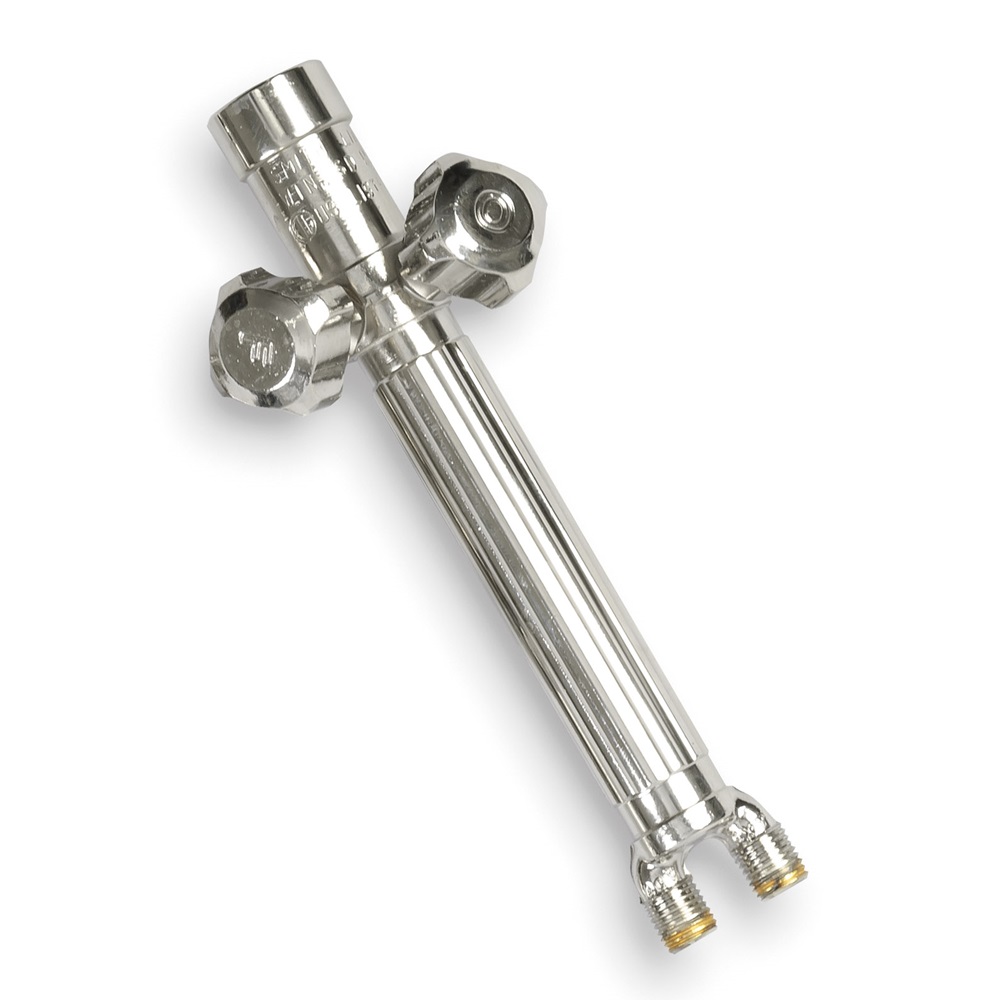
Smith AW1A(AW1)* – (146mm, 170g, OD 17.5mm) It’s nickel plated and looks great. It’s top quality and made in USA. It’s expensive and uses proprietary mixers. It’s light, but the coupling sticks out past the valves, and the handle length below the valves in on the short side, barely longer than a jewelers torch. You effectively lose about 20mm of handle, which makes it relatively cramped, and it’s more tip heavy. Expect the hose fittings to end up in your palm. Check valves can help extend the handle. The cylindrical part of the handle under the valves is ~90mm. The handle is a little fatter than Victor type torches. Mixers are chunkier too offsetting some of the weight reduction. You can turn the tips in the torch body while the torch is on because o-rings aren’t a taper fit like J-types, but you don’t really need to with light hoses (it’s basically not useful at all with light hoses). Tube-in-tube for high flow and a strong outer tube. They used to have lifetime warranties including wear and tear, but Miller got rid of that. AW1 is the old equivalent model, but also doesn’t have a lifetime warranty. Nickel plating means no coins smell on your hands. Even with these designations, the designs varied over time. It’s hard to justify the premium and incompatibility without the warranty and higher prices. My old torch was a Smith though and I did like it. To me, the valves feel very nice despite with smooth even action and little backlash. They’re very attractive and just feel very well made and exclusive with that bright shining nickel plate instead of looking like a black tarnished bathroom fitting after 10 years. It’s like the Campy of torches, great quality, great fit and finish, bling, timeless, unique, exclusive, proprietary and not really any better in practical terms, even worse in some ways.
Special Features:
Lightweight
Nickel Plated
Must use Smith AW specific mixers
Can rotate tips with flame on
Valve knobs engraved
Female threaded body
Short Handle
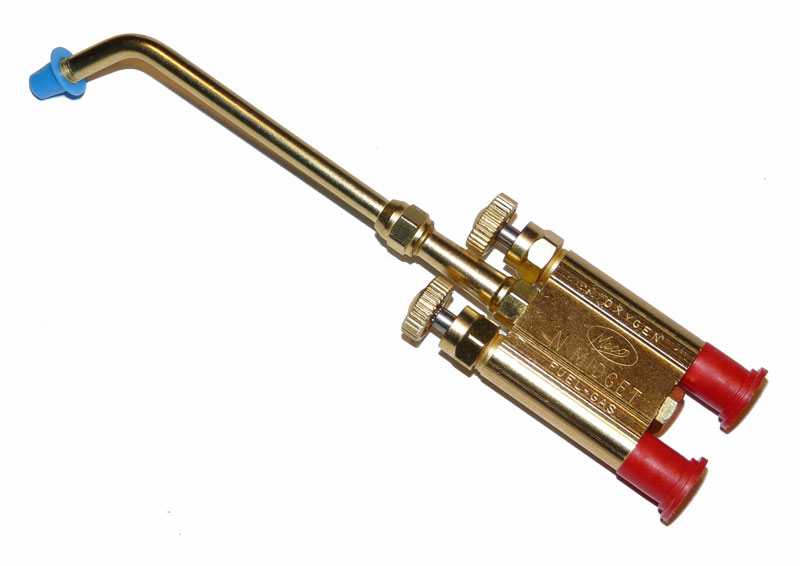
Meco Midget* – (170g) It’s somewhere between a jewelers torch and an aircraft torch. Unlike most aircraft torches, it can’t take a cutting attachment, but you don’t need that for frame building and a little oxygen generator won’t be able to keep up. It uses its own tip system, but the tips are very good and many of the upgrade tips are threaded to the Meco standard. It does not require a tip adapter, so it’s really closer to 110g for comparison’s sake. The shape is very different from the others though, it’s more rectangular than cylindrical. One interesting quirk is the long valve barrels allow for anti backlash springs, so I would expect the valve action to be very good. Some people like it, some people don’t. It’s fairly expensive though. It’s like a mini-velo, quirky and compact, some people love them and it’s perfect for them, some people hate them and it’s literally all just disadvantages with no redeeming features. Or maybe Huret, it’s just weird and different.
Special Features:
Featherweight
Antibacklash valve springs
Integral mixer and tip tube
Uses Meco or Paige tips without any additional adapters
Extra short and flat body

Victor/Turbotorch J28(J27 etc) – (152mm, 241g, dia 15.9mm) Most of the other torches in this list are modeled after Victor J series torches. It’s the “original” and 28 is the current production version. It’s a little heavier, but you’re not throwing your torch in the back of a truck, so extra strength isn’t needed. Tube-in-tube for high flow and a strong outer tube. The hook created by the offset fuel fitting feels nice in hand with a finger resting in it. Victor advertises built in check valves and flashback arrestors on most torches, but the J28 does not have them. Victor used to be made in USA, but no longer. Unlike some companies, they didn’t keep the quality up either, despite charging a premium. They’re still good torches, but it’s hard to say they’re still top shelf and worth the top shelf price. If you have an older J torch, use it, otherwise, don’t buy Victor new. They are one of the biggest if not the biggest name in oxyacetylene torches, so if you happen to receive a second hand torch, there’s a decent chance it’s a Victor and there’s no shame in using a Victor, but Smith has commonly been seen as the more premium of the two and it’s just a quirk of marketing that Victor is now more expensive in addition to not being made in the USA. Most of the other torches below will be described in relative terms. The Shimano of the torch world, the standard setter, sturdy and reliable, or at least it used to be until quality started slipping, just like Shimano.
Special Features:
Ball bearing tipped valves
Contoured handle at hose fittings
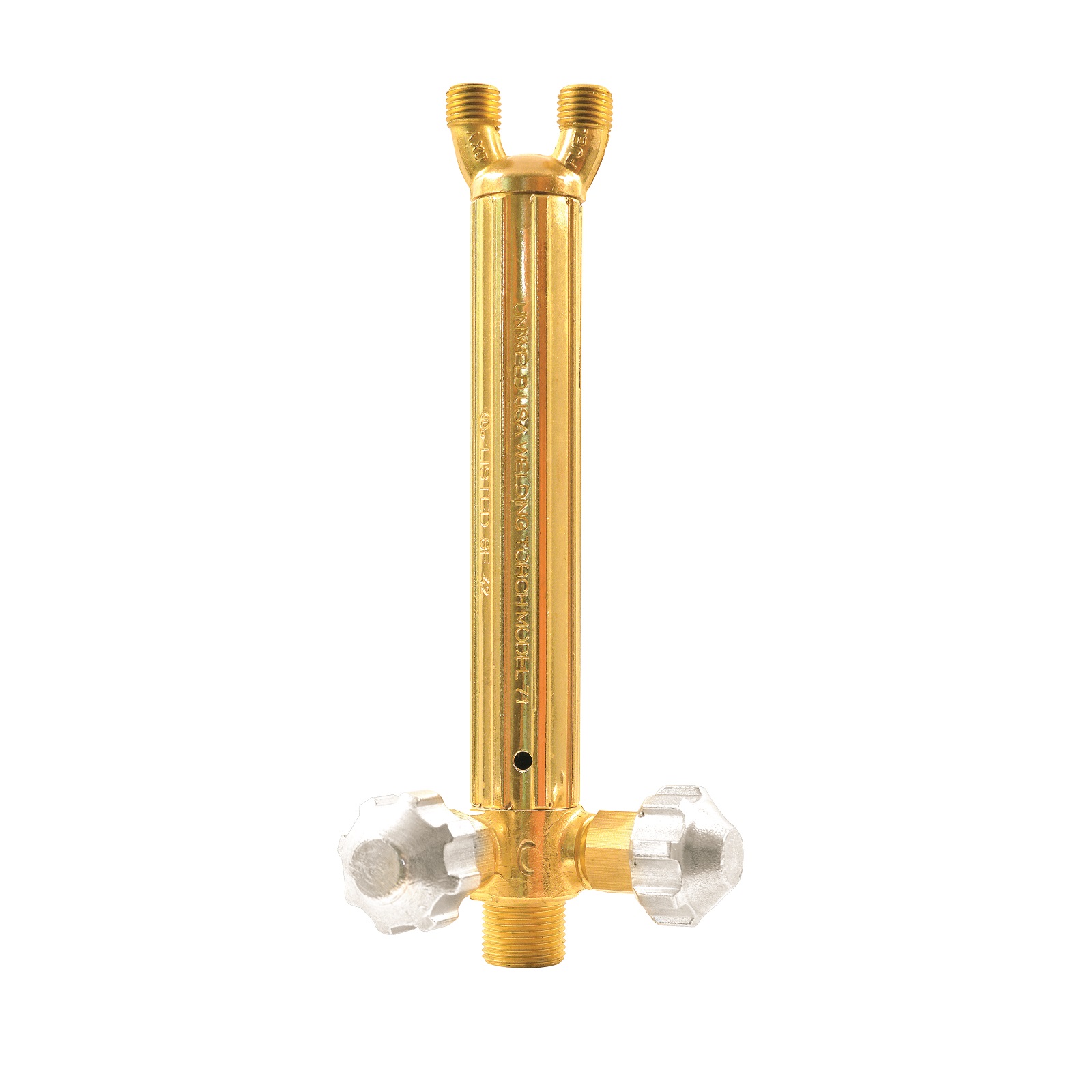
Uniweld/Ameriflame 71* – (152mm, 181g) Victor J type torch. It’s a bit lighter with a larger handle and not as strong. I think it’s twin tube construction but it doesn’t impede flow. The design itself is derivative of older Purox W-200 torches, but has Victor tip compatibility. Still made in USA. Different vintages come with different knobs. Uniweld tends to be not top quality, the construction and fit and finish isn’t as nice as others, but it’s still good and tends to be a bit more affordable. They have aluminum valve knobs which have a tendency to rarely fall off the needles rendering the torch useless and possibly dangerous, but I’m pretty sure this happens when the torch is mishandled and not in normal use. It’s a bit less sturdy and easier to dent, so don’t abuse it, but you should understand the compromises between strength and weight as a framebuilder. Still better and cheaper than a “genuine” J28. Maybe something like older SRAM without the high tech gadgetry. Nipping at Shimano’s heels and chasing Victor’s coattails, a bit cruder, but also a bit lighter. It doesn’t really fit. Maybe more like Suntour, smaller company, less marketing, less polish, but better in other ways, lighter and cheaper with solid performance.
Special Features:
Lightweight
Ball bearing tipped valves with large aluminum knobs
Slightly larger body diameter
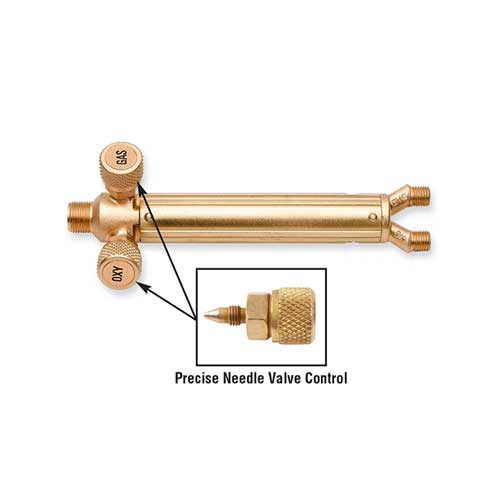
GOSS TW-5A – (152mm) There’s not a lot of info on these nor do they seem to be widely available online. Made in the USA. I have not seen one or handled one in person, although I have some GOSS tips. They used to also make third party Smith compatible tips. The knobs are labeled with stickers and knurled, but use a regular needle design without the ball bearing tips. The construction is twin tube like the Uniweld, but it has brass knobs meaning it is likely heavier. It doesn’t seem bad for the price and I wouldn’t turn one down. Based on the picture, I think that this may be the fattest torch in the line up if you don’t like your torches too skinny.
Harris 15-5(15-4 etc.) – (146mm, 230g) 15-5 is the current version, there’s a Harris 15-4 etc. Some say it is supposed to be Victor J compatible but it doesn’t seem to be. Harris also used to make torches sold as Craftsman. The HV V-series variant may be Victor J compatible and seems fine as a Victor variant. Harris seems to make torches in all sorts of random countries. Buy a Harris torch of unknown vintage and it was probably made in Europe somewhere. Buy another one and it was in a different European country. Buy another one and it was made in USA, because you might not have realized it from the European manufacture, but Harris is an American company. At one point they used to advertise “Made in Europe” for torches. Bizarre. Harris has a injector mixer which is good if you’re pairing it with city gas and not propane, and you also don’t have to walk the flame up alternating increasing oxy and propane, but you need high oxygen pressure. You can use it if you have one, but Harris torches are too expensive for no reason to buy new without any justification. This is more of a use it if you have it torch. That being said, Harris Safety-Silv silver fillers and fluxes are great. It’s that weird “boutique” CNC component company that is inexplicably more expensive despite offering nothing and they don’t even look that good.
Special Features:
Color coded valves
Must use Harris specific mixers
Harris 50-10 – (203mm, 360g) Not a J type torch. It has “B” fittings and is called medium duty, but it just about aircraft size. It uses different mixers. It gets a mention here because it has a neat gas saver lever that turns off the gas except for a small pilot light. Notably heavier however. Only buy if you are loaded.
Special Features:
Relatively heavy
Color coded valves
Must use Harris specific mixers
Has shutoff lever
B hose fittings
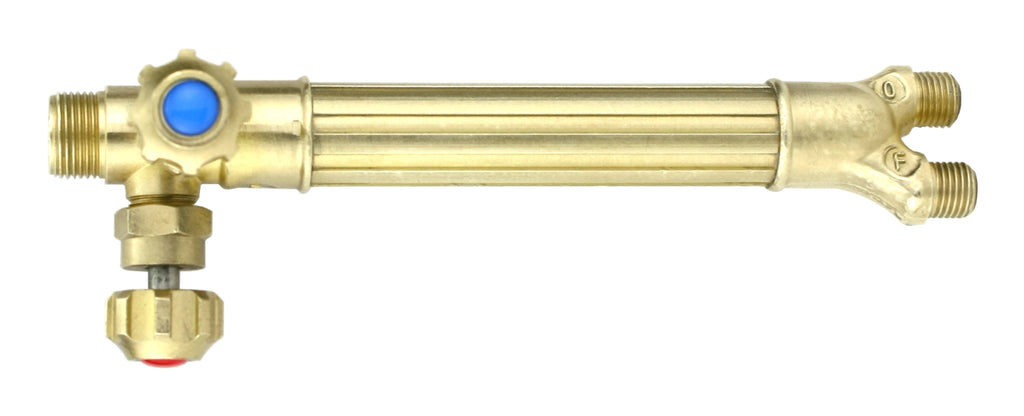
SUA Ligth[sic] – (150mm, 246g) Victor J type torch. Less than half the cost of others but of lesser quality. Sold on Amazon for easy returns though. If not, return and try again. The fit and finish is decent with no sharp edges or rough spots, but it’s clearly not the equal of better torches. Valves are not the smoothest or most consistent, but there’s a packing nut to make sure it doesn’t leak. There’s about 1/4 turn worth of backlash, which is annoying given that it only takes 1/8 of a turn for full oxygen, however you can feel when the threads start engaging properly or you could always press down or pull when adjusting the valve. All torch valves have backlash, but the straight shaft packing and lower quality makes it readily apparent here. Inexplicably, the base is at a random angle compared to the valves, which the brand says is normal. The color coded dots are just sticker adhesive. The Victor style hook created by the offset fuel fitting feels nice in hand with a finger resting in it. I think it’s functional, but you’ll notice the quality of better ones. One thing I actually quite like about it, although it looks crude, is how far the valves stick out. It lets you rest your fingers against the stem under the knob with little risk to touching the knob, giving a very roomy feel to the handle. The valves are very chunky, and the torch feels very solid. I don’t think it’s going to spontaneously fail, nor does it feel like it’s going to break. I think you might get upgradeitis and not like the valve action. If it weren’t for the random body angle and the bad valve action, I would actually recommend it since there are things I like about it. I would say save up a little and buy yourself a keeper. Also seems to be sold under the VEVOR brand. That no-name department store derailer that maybe works, maybe it doesn’t, maybe it’s practically the same as a Shimano Altus.
Special Features:
Extra long color coded valves
Contoured handle at hose fittings, but at an odd angle
RXWELD/AWLOLWA Ligth [sic]- I don’t know anything about these other than they’re about $70 with 3 tips on Amazon. They look like a more faithful Victor clone than the SUA. Come with check valves, but I don’t know how much I trust no-name safety equipment when Western ones are pretty cheap. May or may not be decent, but no warranty and no company to stand behind it, so don’t expect quality.
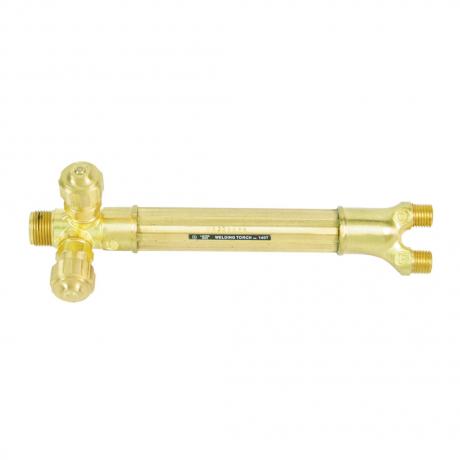
Special Features:
Ball bearing tipped valves
Contoured handle at hose fittings
Gentec 140 – (152mm, 241g) Victor J type torch. Made in China, but okay quality. Not top shelf though. Not immune to issues but has a warranty at least. It’s the closest to being a J28 clone. The Victor style hook created by the offset fuel fitting feels like in hand with a finger resting in it. It is also sometimes sold bundled with screw on check valves which tends to be cheaper than buying them separately, but the body itself is the same. Like Microshift, makes some faithful Shimano clones, but also chooses to innovate from time to time.
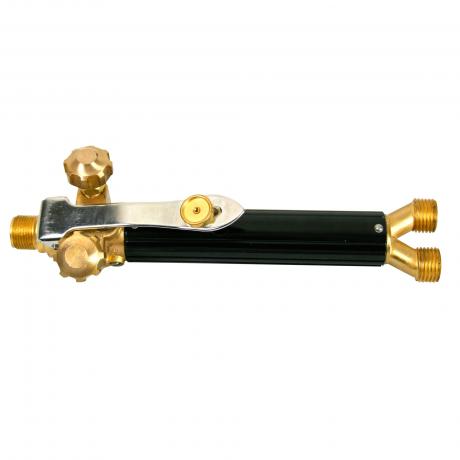
Gentec 342T-F* – (168mm, 318g) It’s like the Harris 50-10 gas saver torch except with Victor J tip compatibility and a lot cheaper, but still more expensive than plain Victor J type torches. If the novelty of a built in gas saver intrigues you, this makes a lot more sense than a Harris 50-10. Slightly lighter than a 50-10 but still heavy.
Special Features:
Relatively heavy
Has shutoff lever
B hose fittings
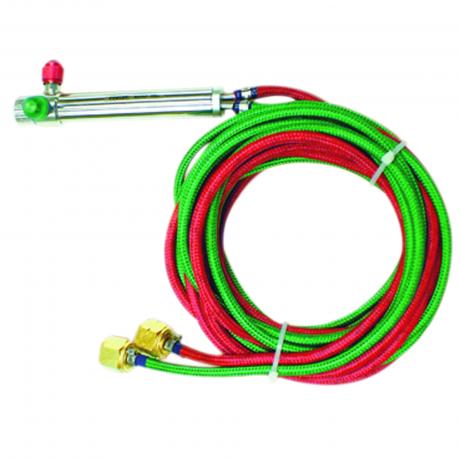
Gentec Compact* – (112mm, 100g)It’s a hybrid of their jewelers torch but with Victor J tip compatibility and improved flow from J type mixers. It comes with 1/8 hoses and is very light and small. The tips for it are exceptionally light, but short and the biggest tip they advertise for it is a #2 equivalent, but you can fit J type bigger tips to it. I think the construction is twin tube and flow is compromised due to the small size and jewelers torch valves, but seems to have a max flow about 7 LPM at a pressure of about 7.5 PSIG. Max flow at 20 PSIG is over 10 LPM, so it’s not too small to be used with either size of concentrator, but on the small side. The valve knobs are color coded but small in diameter and packing tightness is unadjustable and threads are more exposed to grit, although the packing itself is well protected. The smaller valves do have an advantage though, it’s about 1/4 turn instead of 1/8 turn for max oxygen like on other torches. Seems similar to a Messer MINITHERM, although Gentec made a version of with with a different head as a little torch equivalent. Although the measurement is short, I only measured the body without the barbs, and the handle length below the valves not including the fittings is a hair longer than the Smith AW1 and a hair smaller in diameter. Basically it’s cramped, but only as cramped as a Smith AW1A. Sold as a premium lightweight alternative to the Gentec 140 J type torch for HVAC. Barb fitting means less weight by an ounce give or take due to lack of real hose fittings, but also prevents the installation of check valves. Newer Gentec Small torches might share the design, but with a little torch adapter included, although Gentec won’t confirm this. Older Gentec Small torches do not share the double o-ring design and are only little torch tip compatible. The valve quality doesn’t seem great, it’s okay. Consider that Smith brazing hose costs nearly as much as this torch that includes hoses though, and it is still more nimble than any of the other torches with Smith brazing hose.
Special Features:
Featherlight
Chrome plated
Colorcoded valve knobs visible from any angle
Small valve knobs
Valves without adjustable packing
Short handle
Barb fittings with included 1/8″ hoses

| Length | Weight | Diameter | Tip Compatibility | Hose Fitting | Finish | Valve Knob | Warranty | Origin | Approx Price | |
| Smith AW1A | 146mm* | 170g* | 17.5mm | Smith AW/AT | A | Nickel | Engraved Nickel plated | 5 year | USA | $160 |
| Meco Midget | 70/171mm* | 170g* | N/A | 1/4-28 | A | Brass | Brass | USA/Mexico | $250* | |
| Victor J-28 | 152mm | 241g | 16mm | Victor J | A | Brass | Brass | 5 year | Mexico | $185 |
| Uniweld 71 | 152mm | 190g | 19mm | Victor J | A | Brass | Aluminum | 1 year | USA | $110 |
| GOSS TW-5A | 152mm | Victor J | A | Brass | Labeled Brass | 3 year | USA | $70 | ||
| Harris 15-5 | 146mm | 230g | B-15-3 | A | Brass | Color Coded Brass | 1 year | USA | $200 | |
| SUA (VEVOR?) Ligth[sic] | 150mm | 246g | 17mm | Victor J | A | Brass | Color Coded Brass | 30 day | China? | $45 |
| RX WELD/ AWLOLWA Ligth[sic] | ? | ? | ? | Victor J | A | Brass | Brass | None | China? | $70 w/ tips |
| Gentec 140T | 152mm | 241g | Victor J | A | Brass | Brass | 2 year | China/Taiwan | $90 | |
| Gentec Compact | 112mm* | 100g | 17mm | Victor J | 1/8″ Hose Included | Chrome | Color Coded Aluminum not adjustable | 2 year | China/Taiwan | $170* |
Torch handles really don’t affect performance much, and many of them are very similar. You could buy based on the above chart, but in the end you basically buy one that matches your personality or build philosophy and doesn’t leave you wanting to upgrade later. There is no perfect torch. For every single one of the above torches, I could tell you a reason it’s better and a reason it’s worse, and how it really doesn’t matter much.
Warranty details vary, and warranties are sometimes counted from date of manufacture.
To breakdown criteria:
Length is length, although, the compact torch and Meco are measured slightly differently. The AW1A’s layout puts the valve lower making the handle feel more cramped. Both the AW1A and compact torch are ~90mm below the valves, and ~15-20mm shorter than the alternatives, although the AW1A can be extended with check valves if you’re willing to grip those. If it weren’t for the short grip/valve placement on the AW1A, it would be my top pick despite the cost and proprietary tips. It doesn’t matter if using a pencil grip. Aircraft torches are already on the short side, so I feel in general, longer is better, none of them feel too long.
Weight is weight, although this doesn’t tell you anything about balance. Some weights are not directly comparable, for the Meco and compact torch. Generally the lighter the better, you can also feel differences in weight distribution. Generally, lighter is better, but I wouldn’t obsess too much over it. Even the heftiest torches here are not especially hefty. Hose weight has a bigger impact, and a light handle with screw on tips feels a little worse balanced with heavy hose.
Diameter is diameter. All of these are very similar in diameter, although I think the Harris is the largest. Diameter is personal preference, larger fills up the hand better and gives you more torque, smaller makes it quicker to roll, but these differences are marginal given the spread of diameters. Within the range of aircraft torches, bigger diameter is better, none of them feel too big.
Tip compatibility determines what tips or what adapters you need. Victor J style tips are the most common. Smith and Harris tips tend to be heavier in both the mixer and tubes. The Smith tips let you turn the tip while the flame is on, and it the connection feels more solid because it isn’t sitting on o-rings. However, the external mixer threads are more vulnerable if swapping between tips. External threads on the torch will usually have a union nut on them and will be more likely to be protected, although the torch is more costly to replace if damaged. Smith’s tips end up having a big heavy mixer, and mess with the valve placement on the Smith handles. Victor’s and Harris probably have a more reliable seal when it comes to dealing with wear due to the taper, but probably a less reliable seal when not tightened properly and they seem to never fit super tight or firmly. If I had my choice in mixer interfaces on technical merits, it would be Purox style, which is stepped instead of tapered, but that just isn’t industry standard.
Hose fittings are usually the smaller A size paired with 1/8″ or 3/16″ hoses. They make it difficult to fit torch side flame arrestors which protect hoses from exploding, but those also add weight and bulk. You don’t really want to run adapters because they add weight and bulk. The only exception for this is the compact torch with has barbs. That means check valves can not be added, but it also means the hoses are a bit lighter due to not needing threaded connectors. Check valves can be added to the AW1A helping to offset the short handle length. Victor J28 and the closer J types (Gentec 140T and SUA Ligth) have offset fittings so it creates a nice little finger hook on one side, and is flatter on the other side for improved ergonomics.
Finishes affect the look, but some people also have allergies to different metals. Brass is an alloy of copper so could affect people with copper allergies. Brass can also result in metallic old coin smell on your hands since many coins are also copper alloys. Brass will tarnish dull and brown over time, nickel and chrome might wear or peel over time exposing the brass underneath. If not allergic, I feel that plated is superior.
Valve knob styles vary in design. It’s nice to have one with clear indexing features so you can easily turn 1/8 of a turn or something, which the Meco and compact torch lack. Color coding is safer, followed by engraving. The packing on most valves can be tightened with a nut, adjusting how much friction there is on the valves and letting you tighten in case of leaks, the exception being the compact torch. Most modern valves have packing for a straight smooth valve stem, so making them tighter does not help with backlash and just increases friction. More precise threads result in less backlash, and finer threads result in less adjustment per radial unit of backlash. Some older torches, like over AW1s have threaded packing, which are more prone to wear, leaking and contamination, but also can reduce backlash when tightened and higher friction sensitivity to packing tightness.
Warranty policies vary, be sure to examine the warranty policy. Many start from date of manufacture, not date of purchase. Some companies will RMA/RGA with a prepaid label, some won’t, some will do an over the counter swap at your local distributor, some won’t. Smith used to have both a lifetime warranty and service plan, but I’m not sure Miller honors it anymore, even for lifetime marked torches.
I also have a preference for fluting on the Smith , followed by Uniweld. The angle and corners of each spline is less sharp, but they provide adequate grip. Victor, Gentec and SUA have grooves that feel like right angles with a pattern that’s like a square wave wrapped around the handle. It might provide more grip, but I don’t like the feel barehanded, especially pencil grip. The Uniweld splines are more like a skiptooth pattern, so the handle tends to feel lumpy and polygonal when rolling it in your fingers, again, especially with pencil grip. I tend to not like fine knurling like on the Harris either because the teeth tend to be sharp triangles and they trap oil and grime.
China is capable of making things just as good as things made in the USA, but my feeling is all the torches listed here not made in USA did so to cut costs and quality. I don’t feel any of the non-USA torches are just as good but less expensive, as might be true of other Chinese made products. Quality also varies between the US brands. An import torch may be of adequate quality however, so I wouldn’t let origin scare you from a torch, just realize that lower quality usually comes with lower price. They’re cheaper for a reason and you don’t really get more bang for your buck, although between all these options, you don’t always get what you pay for either.
The asterisks in the chart above merit some important notes. Smith AW1A torches have their valves about 20mm lower, so the handle length feels shorter and more cramped. The Gentec Compact torch is measured without the barbs, and the cylindrical part of the handle below the valves is essentially the same size as the Smith AW1A at around 90mm, which is maybe 20-25mm shorter than the handle of other torches. A Smith mixer also seems to weigh 10-20g more than the equivalent J type mixer, and even though it runs a skinnier 1/4″ tip tube, they often are no lighter than 5/16″ ones. Think oversize thinwall tubing. The Gentec Compact comes with 12′ of 1/8″ lightweight hose. The Meco comes with a 4″ tip tube included and the mixer is integral to the design, so the length of the handle is very short, and while expensive, is not as expensive as it might first appear.
If you pride yourself on fine craftsmanship and make refined and luxurious bicycles it’s the Smith or Meco. Yes Victor and Harris are more expensive than Smith, but no, they aren’t as nice as Smith. Smith is a genuine top shelf torch that also doesn’t make your hands smell funny if you handle it without gloves. As much as I like Smith torches, the proprietary mixers, the limited tip options, the lack of length etc. bother me. The quality is superb, it’s just not perfect and better in every way. Meco suffers from similar weirdness and incompatibility.
If you fancy yourself a no-nonsense builder that focuses on performance, versatility and/or function, it’s the Uniweld 71. I think the aluminum knobs are a bit of an eyesore, but brass is even heavier than steel. It would still be a top pick among J type torches even if they were all the same price and all made in USA. It’s not necessarily better that every torch in every way, but if there isn’t something specific you want from a different torch, this would be the one. It’s all around good even if it doesn’t exude the same sense of elegance and excellence that Smith does. There’s few things to dislike about it, and it’s good in directly comparable metrics like weight, length and diameter. Although there’s no shame in using a Victor if you already have one, especially an old made in US one.
If you’re cheap stingy hobby builder on a shoestring budget and aren’t selling MUSA and don’t buy MUSA, it’s the SUA. Try explaining to a customer paying premium custom bike money that you use cheap pretty okay equipment and they’ll wonder if they’re buying a cheap pretty okay bike. For that reason alone it’s a waste of money for a pro builder. The build quality isn’t really there. It feels sturdy enough, the fit and finish is actually nice enough with burs and flash ground down, you can adjust the valves so they don’t leak, and it seems like it would do the job, but the valves aren’t refined and the fact that the head and lower body are at a random angle relative to each other means you might find yourself wanting to upgrade in the future.
If you inherited a torch from somewhere, it’s probably a Victor and there’s nothing wrong with a Victor. They’re common and plentiful on the second hand market, although I would advise against second hand purchase in general. Despite it sounding like I have nothing good to say about Victors, older Victors are actually nice, and there’s no shame in owning a Victor, I just don’t feel they’re worth the cost of entry and other torches are at least as good in many ways. The little finger hook the hose fitting makes feels really nice in hand with the right grip, it’s something I miss on other torches. If I had to own a torch with that feature and cost wasn’t an issue, it would probably be a Victor. If I already owned a Victor I wouldn’t spend money on a Uniweld.
If you’re a maverick, it’s the featherlight Gentec Compact or the Meco, these are torches with their own pros and cons and not just the same as the others. It’s worth noting that the Meco includes the mixer and tip tube in the weight and price, and the Gentec Compact torch includes 1/8″ hoses to fit the barb fittings, but can’t fit check valves. Like the Smith, the Gentec is plated, so no smelly hands. These aren’t directly comparable in terms of price or features. They’re both small, but will also end up around 100g lighter than other setups at less than 200g without hoses.
If you’re buying from your local welding store to support local businesses or for warranty reasons, it’s one of the other brands.
No specific recommendations except that some torches are not good values. Asterisk means worth considering. Uniweld 71 is the Victor J style torch of choice, the others are not strictly Victor J type torches but still worth considering.
Tip Tubes & Mixers
Selection of propane specific tips tends to be bad and requires a mixer and adapter tube that works with threaded nozzles. This removes the ability for tool free tip changes (the big advantage of a modern double o-ring design) unless you buy lots of tip tubes.
Some torches have built in mixers. If you are planning on using threaded nozzles, you are basically converting your HVAC torch into one with a built in mixer. The fact that mixers are attached to tips is a quirk of the fact that these torch handles were designed to take oxygen cutting attachments, which use a completely different mixer design. It also allows for some tuning of the mixer to the tip, and easy swaps between EP and injection mixers, but having a built in mixer like a Meco is not really a disadvantage. Being able to swap between a cutting head and welding tips without tools or needing to leak test was a big advantage back in the day, but adds pointless bulk and complexity if you’re only going to swap using the threaded tip interface. It offers us no advantage unless you keep multiple mixer-tips around for toolless quick changes, which is why I’m an advocate of having multiple mixers.
There are two types of mixers, injector and equal pressure. Most normal acetylene torches and tips use equal pressure mixers. Alternative fuel mixers may be of the injector type. It has been stated that propane mixers have more oxygen holes because of the increased oxygen requirements, the problem with this being that oxygen is usually run through the center hole. Injection mixers rely on the venturi effect with high pressure oxygen to pull low pressure (0.25-2psi) fuel gas, common with “city gas” coming from pipes or piped in propane, or in ye olde velocipede times, low pressure carbide acetylene generators. Injectors have small orifices to speed up the oxygen and reduce pressure for the venturi effect, meaning that it will have less maximum oxygen flow for any given pressure level, but low restriction for the fuel. In other words, if you want a big tip with a big flame and only a 5psi oxycon, an equal pressure mixer is more likely to allow sufficient flow than an injector.
Which style is better is debatable. There are people who assert that one is safer than the other. Some assert injector is safer because is requires oxygen to pull the fuel. Some assert equal pressure is safer because the high oxygen is more likely to cause backflow into the fuel lines. Injector mixers are supposed to be used with high oxygen pressure and low fuel pressure, although that never stopped anyone from treating it like an equal pressure mixer (effect lessened when fuel pressure is higher and the oxygen isn’t pulling the fuel). When used as an injector mixer, there is less alternating between fuel and oxygen adjustments to get the flame bigger because more oxygen will tend to pull more fuel along with it. Equal pressure is typically capable of more intensive applications, of which bicycle brazing is not. The big issue with using injectors is they usually expect high oxygen pressures our oxycons simply don’t have. If running 5psi, an injector mixer could become a bottleneck limiting the amount of oxygen delivered and therefore reducing the maximum flame size even if a bigger tip is used. Not all injector mixers are excessively restrictive though.
Smith designs in general seem to be based off of an injector design, but tuned differently. There’s an injector cone on the bottom which is meant to accelerate the oxygen through a small hole past a gap that fuel can get in. One old 60’s era smith tip and mixer I tested behaved like an injector without a nozzle, but had backpressure on the fuel side with the nozzle.
Mixers and tip tubes listed here are purely informational. Only adhering to manufacturer’s recommendations for propane is advised.
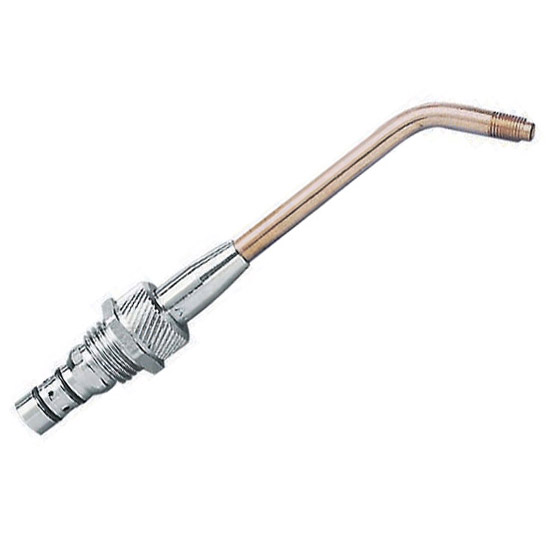
Smith AT61 – Injector style mixer. Only compatible with Smith AW1A and threaded for 1/4-32 at the end. Smith tips for this adapter are bad, so you will almost certainly be using this with a paige NK adapter and paige or meco tips. You may want to try turning down the pressure to 2 psi and see if the oxygen pulls the fuel. At one time it was advertised as working down to 0.25 psi of fuel pressure, but it’s hard to get a straight answer from them. It could very well be that the only reason AT61 was originally recommended for propane/natural gas is because of low pressure piped in propane/gas for buildings. I’m not sure if anyone is really keeping up with Smith technical stuff over there since Miller bought them.
Smith AT60 – Equal pressure(?) style mixer. Similar to mixers on AW tips. Way back when, Smith used the same mixer for propane as acetylene. Only compatible with Smith AW1A and threaded for 1/4-32 at the end. Similar to above. Smith tips for this adapter are bad, so you will almost certainly be using this with a paige NK adapter and paige or meco tips. Smith says for acetylene though, but the Versa-Torch compatibility illustration is completely arbitrary with some tips being acetylene only, but those same tips being fine for either when attached to a twin flame attachment. I don’t really know that it would be that different from modifying a decently large Smith tip.

Victor UN-J – Equal pressure(?) style mixer. Compatible with Victor J type torches and threaded for 5/16-27 at the end. Victor says it can be used with acetylene or propane (or hydrogen or natural gas). Possibly has more fuel holes simply so it can have enough flow for the biggest tips. The Gentec one is about half the cost from the right vendor, but are basically the same.
Victor UNN-J – Injector(?) style mixer. Very hard to find and very expensive. Compatible with Victor J type torches and threaded for 5/16-27 at the end. Victor specifically says for use with low pressure natural gas 2 psi or under, although also lists it as multi-gas in some places and propane/natural gas specific in others.
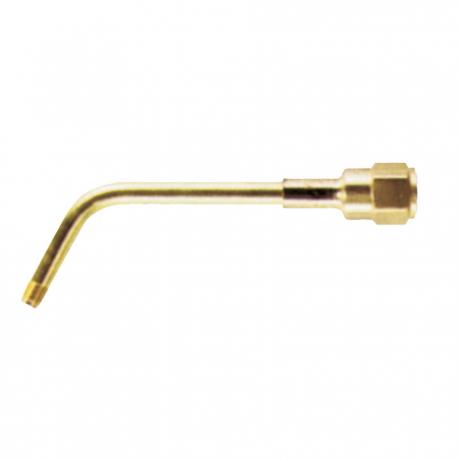
Gentec 881W – Clone of Victor UN-J for half the price, but maybe doesn’t have the spiral mixer.
Harris B-15-3 – Equal pressure style mixer. Compatible with Harris 15 torches and threaded for 5/16-27 for the tip tube. Contrary to other sources, I did not find Harris 15-3 mixers compatible with Victor J type torches. You will have to find a compatible tip tube, and Harris ones require Harris tips, although Harris does have alternative fuel specific tips.
Harris B-15-3S – Injector style mixer. Compatible with Harris 15 torches and threaded for 1/4-32 (nonstandard) for the tip tube. Contrary to other sources, I did not find Harris 15-3 mixers compatible with Victor J type torches. You will have to find a compatible tip tube, and Harris ones require Harris tips, although Harris does have alternative fuel specific tips.
Harris B-15-3F – Injector style mixer. Compatible with Harris 15 torches and threaded for 1/4-32 (nonstandard) for the tip tube. Contrary to other sources, I did not find Harris 15-3 mixers compatible with Victor J type torches. You will have to find a compatible tip tube, and Harris ones require Harris tips, although Harris does have alternative fuel specific tips.

Welding City J – Equal pressure style mixer. These can be salvaged for mixers and only cost $10-11 shipped. Threading is 1/4-26(? — seems slightly coarser than 27 and slightly finer than 1mm) and J compatible, but tip tube is threadlocked. It could also be 1/4″x1.0mm, like the opposite of Campy M10x26tpi, since this is used by SUA. Quality is low, but adequate. Claimed to have a spiral mixer, but doesn’t. The fuel gas holes are inexplicably randomly spaced and not the same mixer to mixer. Unsure if all mixers have the same number of fuel holes, size 2-4 have 3 and look more or less the same.
SUA/Mundaka J – An alternative to Welding City tips, but slightly more expensive. Not sure why you would buy these over Welding City tips except if you insist on buying the SUA torch handle with tips combo. 1/4″x1.0mm threading. They do make some cheap rosebuds though.
Gentec CMP – Injector style mixer. These come on the compact torch tips. Threading is M6x1 and J compatible, but tip tube is threadlocked. They are extremely compact and light, but the oxygen hole is excessively small, and the size 6 only flows ~3.5 LPM at ~8 psi and ~6 LPM at ~20 psi. Size 7 may be a bit better, but these tips call for 25-30 psi of oxygen.
Additional note, there’s a lot of thread sizes for elbows. For 1/4″ tubes, 27tpi such as Victor and Victor clones like Uniweld, 28tpi such as Smith and 32tpi for Harris are commonly used. Welding City seems to measure 26 tpi or so? For 5/16 tubes, 27tpi is most common, but there’s also 22tpi, and some vintage Smith tips have 5/16 elbows. Metric elbow threadings seem to almost always be 1mm pitch however.
I can’t recommend anyone do this, but I like tool-less tip changes because tool-less tip changes mean I’m more likely to actually change tips and I don’t need to keep a wrench around to remove hot tip parts and do leak tests. I don’t want to pay for a half dozen 881Ws plus adapters, so I have a bunch of #3 and #4 Welding City and GOSS mixers that have been repurposed to fit propane tips on the end. Even if the connections aren’t as good as the real thing, once the tips are on and leak tested, you leave them alone and stop any additional wear on the tip/tube interface.
Cheap option: Gentec 881W or adapt tips
Expensive option: Try a compatible injector and EP mixer and see which one you like better then report back, although this is really unnecessary. The Smith AT-61 is expensive, if running the Smith torch.
Tip Nozzles
Oxy propane tips come in 3 varieties. Repurposed oxy-acetelyne tips which just have a single plain hole (Smith). These will not be discussed here because if you have the money for Smith you have the money for better tips, but it’s advised to size up a couple of sizes with propane vs acetylene. Uniweld recommends 1 size up. The second are ones with a counterbore (Victor/Gentec TEN tips). Harris 1390N tips also have a counterbore, but have limited compatibility due to threading. Some people modify oxy-acetelyne tips by making a shallow counterbore twice the diameter of the orifice. This helps keep the flame attached and helps prevent it from blowing out. Propane has a lower flame speed than acetylene so the flame has a tendency to want to just float away when maladjusted. These are equivalent in orifice size to ones without a counterbore. The third has a ring of smaller holes around the main orifice (Meco, Paige, Welder’s Warehouse, H01) which gives even better performance and a sharper flame. Orifice is smaller for the same amount of heat because of the extra flames from the sides and because the pilots allow you to push more pre-mix through the center.

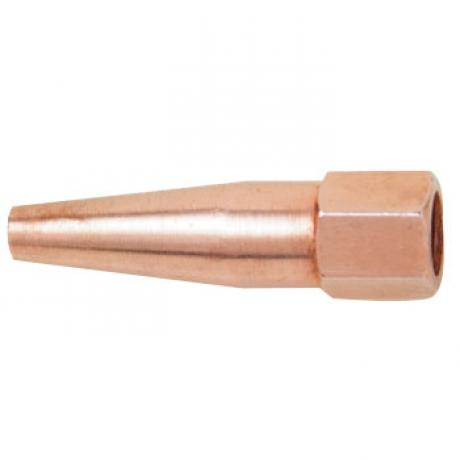



| Carlisle | IMPGEN | Meco | Welder’s Warehouse | H01-6 | H01-2 | H01-2 (Alt) | Hoke | Paige | Gentec | Victor | Harris | Smith | Welding City | SUA | |
| Link | Website | Website | Website | Website | Website | Website | |||||||||
| Threading | 1/4-28 | 1/4-28 | 1/4-28 | 1/4-36(?) | M8x1 | M6x1 | M6x1 | 3/16-40M(?) | 1/4-28 | 5/16-27 | 5/16-27 | 3/8-24M | 1/4-32 | J mixer | J mixer |
| Style | Knurled Pilot | Knurled Pilot | Knurled Pilot | Fine Slotted | Coarse Slotted | Coarse Slotted | Coarse Slotted | Hexagon Pilot | Hex Pilot | Counterbore | Counterbore | Countersunk | Plain | Plain | Plain |
| $26-35 | $30 | $30 | $8 | $2 | $2 | $2 | $6 | $20 | $15 | $25 | $10 | $10 | $20 | ||
| Origin | USA | USA | Mexico/USA? | Taiwan? | China | China | China | China? | China?(CIXI HC) | China? | Mexico? | USA | USA | China? | China? |
| Rack Fillet/ Braze-on(XXS) | OX-1 (28) | OX1 (28) | OX-1 (28?) | #1 (28) | #3 (28) | #1 (28) | #2 | TEN-0 (35) | TEN-0 (35) | 2N(35?) | 0-W-J | ||||
| Fillet/ Braze-on (XS) | OX-2 (35) | OX2 (35) | OX-2 (35?) | #3 (35) | #1 (35) | #5 (35) | #3 (35) | Pencil (37) | #3 (35?) | TEN-1 (40) | TEN-1 (40) | 3N(42?) | 1-W-J | #1 | |
| All-purpose (S) | #2 (39) | #4 (39) | Small (41) | #4 (38?) | TEN-2 (46) | TEN-2 (46) | 2-W-J | #2 | |||||||
| All-purpose (M) | OX-3 (46) | OX3 (43) | OX-3 (42) | #5 (43) | #3 (43) | #5 (43) | Brush (47) | #5 (42) | 4N(52?) | 3-W-J | #3 | ||||
| All-purpose (L) | OX4 (52) | OX-4 (53) | #7 (55) | #5 (51) | TEN-3 (60) | TEN-3 (60) | 5N(60?) | 4-W-J | #4 | ||||||
| BB/Crown (XL) | OX-4 (60) | OX-5 (63) | MA-1/MA-2 | TEN-4 (73)/883TEMFN-5 | TEN-4 (73) | 7N(76?) | NE153(86) | MFA-J #4 |
Many Gentec tips made in China, uncertain if TEN tips made in China
Paige lists CIXI HC of China as manufacturing partner on Etsy
Meco torch is “Made in USA, Assembled in Mexico” like some Victor products, uncertain where Tips made
Welder’s Warehouse region of manufacture and threading information is second hand, they will no longer disclose this info
H01 tips come from Aliexpress, it’s a safe assumption they’re made in China
H01-2 variant I received seems to have #4 as ~1mm, the brand you actually get is highly variable
There is some uncertainty if threads said to be 1/4-28 are actually 1/4-27
| Brand | Size | Orifice | Propane (~LPM) | Oxygen (~LPM) | |
| XXS | Harris | 2N | 35? | 1.5 | 6 |
| S | Harris | 3N | 42? | 2.5 | 10 |
| S | Victor | TEN-2 | 46 | 1 | 3.5 |
| L | Harris | 5N | 60? | 2.7 | 11 |
| L | Victor | TEN-3 | 60 | 1.5 | 4.5 |
| XL | Harris | 6N | 3.1 | 12.5 | |
| XL | Victor | TEN-4 | 73 | 4 | 11.5 |
Tip Sizes
All-purpose means all-purpose. This goes for S/M/L. They can be used for the other tasks and a frame can be fully built with TEN-2 tip (or 3 or 4 for that matter). It is not uncommon to settle on one size for everything. The other tips are nice to have. You don’t need to worry about S/M not being hot enough, they are hot enough.
S is superior for fillets because fillets benefit from precise flames, especially with propane which lacks the very hot inner cone of acetylene. The same precision also helps with filling stay and fork ends. Again, S is still hot enough for everything, but precise flames result in slower heating times and hotspots when trying to bring things up to an even heat. S heats the slowest making it “safer” when it comes to overheating but also heats locally making it harder to heat evenly. The main benefits are better fillet and filling performance, but if your frame doesn’t use those methods or you use an XS tip for those, then these aren’t beneficial. The S tip is the tip that’s on the small side but hot enough to comfortably perform framebuilding brazing. That being said, S is lacking from a lot of vendors where each size up is +25% or +15% up (which is what victor follows except when they decide to skip a size). Note that even a S or XS piloted tip can sometimes max out a 5L concentrator, but the flame maybe be turbulent at the far end, which produces lots of heat, but in a flame that doesn’t wrap as well.
L is for people who want a hotter flame to work faster for production or to try and minimize HAZ area (heat takes time to spread, think frying pans and hot spots). The large flame makes it easier to bring an larger area up to even temperature, which is a benefit to sleeved/lugged joints. L also runs an increased risk of overheating and creating embrittled steel when trying to apply localized heat. L is also good for fork crowns and lugged BB shells. You don’t need your all-purpose tip to be good at these things if you buy specialized tips for them though. You may prefer a S or L tip if you prefer to to these things without swapping tips. The L tip is the tip that can max out or nearly max out a 5LPM concentrator and still have downwards adjustability to perform other framebuilding tasks. Note that even a S or XS piloted tip can sometimes max out a 5L concentrator, but the L size flame is more laminar.
M is an in-between size, which can still do it all, however it should really be considered a tip that is hotter than S, but not as hot as L, so you have more time to react making it “safer”, but it isn’t as slow heating as S. Since the L tip can typically max out a 5LPM concentrator, the M tip offers a wider range of flame sizes and more versatility. Rather than being a happy medium in flame characteristics, it’s more about speed versus comfort level for all-purpose type tasks. Most vendors don’t make all 3 sizes of S/M/L. In that case M is the tip larger than S and smaller than XL, or the tip smaller than L and larger than XS. The M tip is larger than S or smaller than L, and may or may not be able to nearly max out a 5 LPM concentrator, although it almost certainly should be able to if piloted.
XS gives superior control for fillets, but tip design plays a role here too. Single orifice tips tend to give a longer pointer flame which are good for precision, but also tend to be blown out more easily, even by its own gas flow/flame when brought too close to the brazement. Piloted tips have a more stable flame, but also a broader flame. The fine control of a precise flame helps when trying to selectively and locally melt a fillet or trying to make filler flow with heat rather than just capillary action or trying to apply heat to one tube near the joint without heating the other tube. I find that the all-purpose tips can lay down a fillet, it’s just harder to control and lay down a nice fillet, especially with propane where you don’t have the extra hot inner cone that gives acetylene precision. Other people don’t seem to need an XS tip to lay down a nice fillet though, so it isn’t strictly necessary. It can also be used for small braze-ons, but so can an all-purpose tip. The XS tip gives a more precise flame than the S tip without giving up too much heat for main joint fillets. With a piloted tip, the main advantage is that you can further reduce the flame size without popping.
XXS is even smaller for smaller fillets, or it can be used for main joint fillets if you like a small flame, but it has worse smoothing action. It gets hot enough for main joints, and it gets hot quickly when turned up, but the heat is very localized so there is little heat smoothing and an increased chance of scorching the flux if you try to heat smooth. It is primarily used for rack fillets, which use smaller tubes, have smaller fillets, and require less heat. You do not need it for racks if you are fine with the natural fillets formed by capillary action (aka tinning), although it will help focus heat if you do use it for tinning. It is for building and shaping rack sized fillets. It can also be used for small braze-ons or building tiny fillets around braze-ons if for some reason you don’t like the fillet formed by capillary action. The XXS tip has a very precise flame and reduced heat output for tiny fillets. This is a very optional tip.
XL is for lugged BB shells and fork crowns that soak up a lot of heat. Using a small tip will just result in hot spots and make it harder to flow filler through sleeves joints because the heat will spread faster than you can apply it except right under the flame. This my result in poor filler penetration and take an excessively long time. A big broad flame will get everything up to temperature more quickly and more evenly. A rosebud (#4) is suggested over a large tip, and you can max out a 5LPM concentrator on even an L tip. Propane rosebuds usually start at #6 but that is too big unless running 10LPM at max output. You really do not need larger than an XL tip, even with a 10LPM concentrator. The XL tip is to get maximum heat from 10LPM, or to get broad even heat (rosebud) from 5LPM. A 10 LPM concentrator is wasted without an XL tip, but with 5LPM, this is a very optional tip.
Individual preferences vary greatly, some may consider a non-rosebud XL their all-purpose tip. You may also find you don’t need smaller tips if you are fast and have good heat control. Recommendations are based around getting an all-purpose size then expanding from there. Small all-purpose has the edge for fillets versus larger tips. Large tips heat things faster which has advantages and disadvantages. Some builders prefer larger, but usually not smaller than this.
You may notice that the tip sizes don’t really line up. For Victor/Gentec that’s because they only have one flame (center hole approx 1 size up). For Paige it’s just because their tips are on the smaller size. Orifice size is given in thou (0.001″) simply because that’s what most have them have been reported in. You don’t need to fill a gap because it’s empty and you may find you don’t end up using intermediate sizes.
If you can only have one tip and don’t know where to start, get a S as an all-purpose tip. If S isn’t available, then something like a M single orifice will work. If buying only a single piloted tip and S is not available, then buy an XS if doing fillet, or M for lugs. Otherwise you can build your set around what you plan on doing.
A focus on fillet frames should get an XS tip which is also suitable for open stay/blade dropouts and braze-ons, but not as suitable for socketed joints. An S tip may also help when it comes to fillet BBs due to the build up of fillets acting as a heat sink or you may find you prefer a S for some or all fillet work. I’m not sure there is a big enough difference to need both with piloted tips. M and L can also lay fillets but I like smaller more precise flames for fillet, making an XS/S combo more ideal.
Socketed/lugged joints should use anything between S-XL depending on preferences and technique. L or XL are good for lugged BBs and fork crowns. S or M will work well for braze-ons, dropouts and side-tacking seat stays without remelting the seat cluster, although L can be used as well. Lugs can be done with any, and my opinion is lug brazing is best done utilizing even heat and not trying to use localized heat to pull filler through the brazement a little at a time. XL is only a small or no gain in heat over L when using 5LPM oxygen, and a L flame has more downwards adjustability than XL so it is more versatile. A S/L or S-piloted/XL-rosebud combo would work well, but if you want a different combo or all or just one due to your own preferences, go for it.
If you want to do fillet, lugs and forks, then a XS/S/L set would work. You may have to tailor this to your preferred vendor of tips and may end up with something like XS/M/XL instead. You can of course, also just buy the full range of tips from XXS-XL from your preferred vendor which will usually end up being 4-5 tips, not 6, due to a gap or two that does not need to be filled. I would also substitute the XL tip for one of the rosebud XL tips, even if it is from a different vendor.
The more I try different tips, the more I find I like a narrow piloted XXS-S for targeted heat, (I can do a fillet with S/M which has the edge for smoothing but like XS/XXS for control), an XL rosebud for broad heat (remember we aren’t trying to get the steel higher temperature with bigger tips, we’re just trying to get it up to temperature faster or more evenly with more heat). I use the all rounder less now, with tool-less changes, it’s a lot easier to change out tips.
Tip Styles
Tips for acetylene are usually just a plain hole. These can be used with alternative gasses (of which propane is one), but tend to produce unstable flames because the flame speed of these gasses is lower which makes them detach or blow out more easily. When adjusting propane before adding oxygen, you can make the flame jump off the tip and detach when you make the propane velocity faster than the flame speed, so the flame front ends up where there is an equilibrium in the flame speed and propane speed after is leaves the nozzle. This makes the flame intolerant to large adjustments or blow out when there is too much turbulence, wind or you move the flame too fast.
The solution to this is having a low velocity pilot flame on the tip. The low velocity makes the small flames more stable and less likely to detach. These pilot flames will ignite the pre-mix as it leaves the tip rather than the pre-mix relying on the flame speed to push the flame back to the tip. Alternatively you can think of it as having low velocity pre-mix near the tip to keep the flame front at the tip. One tip manufacturer has proposed that it is turbulence around the orifice that causes the problem, which may contribute, but I think the issue is primary of flame speed. These small flames act like a rosebud and add broad imprecise heat, so at least for a XS/XXS tip, should be as small as possible in terms of flame size and in terms of diameter. Piloted tips can take much more pre-mix than non-piloted. Counterbored tips also seem to perform a similar function by creating a shield of low velocity premix around the base, but not as well.
Knurled Pilot
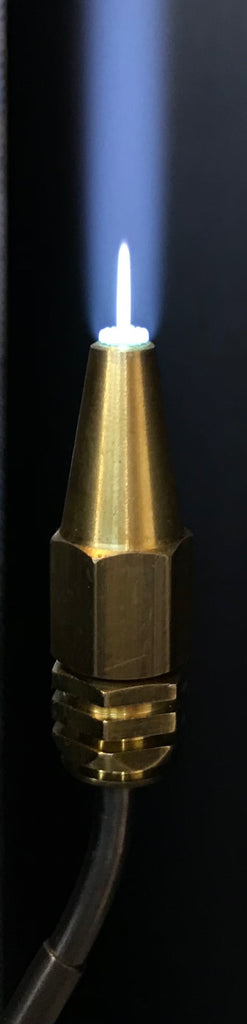
These are preferred over hexagonal pilots. The diameter of the “ring of fire” is typically about 3mm. They can be purchased from Carlisle, IMPGEN, and formerly Meco (unfortunately, Tinman of Tinman Tech passed away), in various threadings but commonly in 1/4-28F. These are make by pressing a knurled insert into the tip, with the ridges of the knurling producing the small jets for the pilot flames. They are typically more expensive at around $30 each but also typically made in the USA. There are also some others made for jewelry torches. Carlisle makes premium versions out of stainless for improved durability. They are all called OX#, but seem to have different sizes. You can see the ring of small pilot flames around the base.
Hexagonal Pilot

Hexagonal pilots are typically found on premium tips that seem to be made in China, but which cost less than the USA made knurled tips. There is very little difference between these and knurled ones but it seems like the knurled ones tend to produce a larger number of shorter pilot flames. The diameter of the “ring of fire” is estimated to be about 3mm, except for the Paige M0, which is too small for framebuilding.
Paige tips are about $20 each and have 1/4″-28 threading, but are not Meco compatible and you must buy an adapter from Paige. Paige has awful, terrible, paranoid customer service and they will accuse people of trying to knock off their tips if ordered without an adapter, and will literally refuse to sell to you if you try to buy tips without an adapter. Many people have had bad experiences dealing with the owner. They used to be Meco compatible, but one day they just decided that they actually aren’t Meco compatible. Their tips are on the small side and the only reason they are recommended if because $20 is more affordable than $30 and they also sell adapters for Smith AT-60 and Victor UN-J mixers which are required if you want off the shelf torch components. If you want to deal with them, don’t talk to them, don’t ask stupid or poignant questions that might set them off (you can basically ask non-technical FAQ questions and might get a sarcastic response saying to read the FAQ), only buy a complete set and order through Etsy.
The Hoke tips are 3/16″-40M(?) threading and only $5-6 but would require custom neck tubes or turning down the threads and brazing them in. There are also some others made for jewelry torches.
Slotted Pilot
Slotted pilot tips are like knurled ones except the slots are cut into the insert instead of knurls and found on tips made in China or Taiwan. It’s not clear why this construction method exists except to reuse machinery used to make cutting torch tips which use similar slotting.
The Welder’s Warehouse (UK) tips are of good quality, and similar to knurled or hexagonal pilot tips. Reportedly they are an odd 1/4″-36 thread and were made in Taiwan, but Welder’s Warehouse no longer answers technical questions and would not confirm the information they told someone else years prior. They’re about $8 each, so very reasonably priced, but have the odd thread and I could not even get information about the thread sizing on the other end of the neck they sell.
The Chinese tips use coarser pilots, ranging from 3-10 in number, and the diameter of the ring for the H01-2 copper clad ones is ~4mm and the one piece ones ~3.5mm. They have M6x1 (H01-2) or M8x1 (H01-6) threads, and necks can be salvaged from H01-2 or H01-6 torches even though the torches themselves are very bad. The construction quality is of course, not great, but they have excellent flame stability and adjustment, but are a bit lacking in precision for the small tips. Even though the pilot openings are large, the pilot flames aren’t. The tips run very hot though, there might be some backfire through the pilots and the counterbore for the face probably absorbs more heat. They’re about $4 shipped for a set of 5, which you might get 2-3 useful sizes out of, so about $2 each. These are fine for medium and large tips, but even a H01-2 #1 tip will easily max out a 5LPM concentrator for an XL or L tip. They’re crude, but provide good performance for everything but fillet tips.
Counterbored/Countersunk
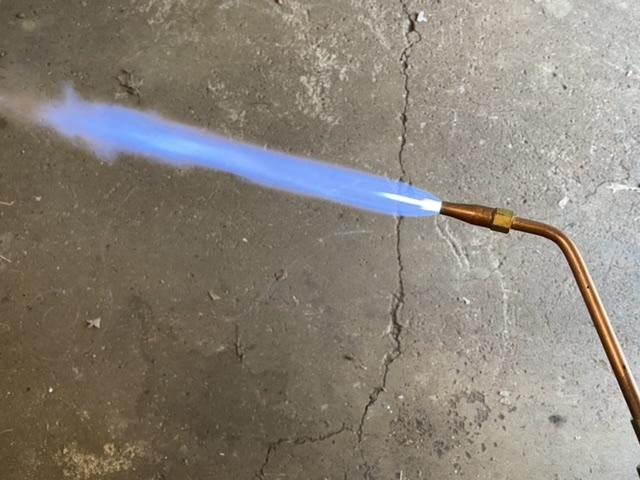
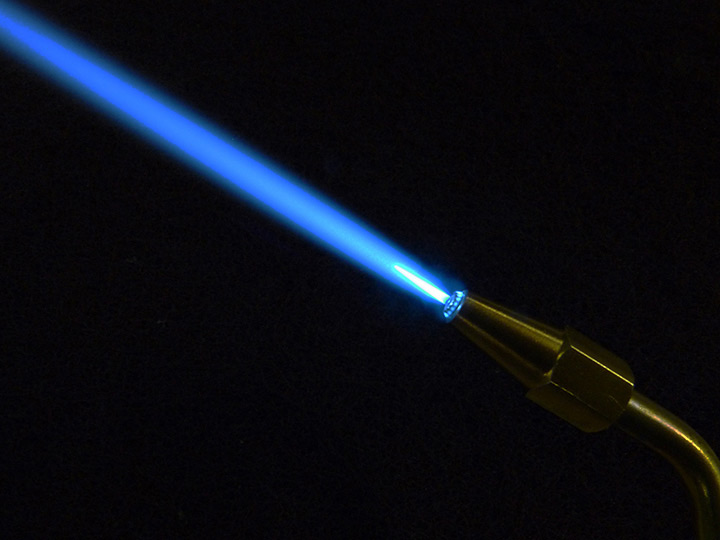
Counterbored tips seem like they’re supposed to produce a similar ring of lower velocity gas around the bottom edge. As seen in the picture, there’s a center cone and a wider cone-like area at the base. These don’t seem to produce quite as stable of a flame as other piloted tips and sometimes not much better than a plain tip. It seems as if these are supposed to work by using flow separation as the bore increases. Or in other words, having a large diameter opening to slow the pre-mix down, but having a narrow high velocity jet in the middle to pierce through the slow part. Lesser flow separations probably why the flame will jump off the tip instead of just gradually increase in distance. I have not had great results trying to counter bore tips and they don’t seem that much more stable than plain tips. I could not reproduce the cone pattern in the picture, but counterbored was easier to adjust and could support a larger flame. I believe the lower stability has to do with the fact that the low velocity gas is caused by the way the pre-mix flows in the air, making it susceptible to turbulence and blowback, whereas piloted tips have independent low velocity ports. The Victor versions are hard to obtain now and the Gentec ones seem to run about $15-20, making them not great values.
Rosebud
A rosebud tip is an array of single orifice holes usually in a circular pattern. This keeps the flame short and broad while having enough velocity at each hole to prevent the flame from receding into the tip. The flame is lower broader than an equivalent single orifice tip, which causes the rosebud flame to wrap around the tubes better and apply heat in a broad area. They do make propane specific ones, usually with counterbores for each hole or a collar at the end, however propane rosebuds typically start at #6, which requires 10LPM of oxygen at a minimum.
Plain bore rosebuds go down to #2 and #4 (or smaller for jewelry), and sometimes advertised as being propane compatible. A SUA #4 rosebud only costs $25 including a J compatible mixer, or $15 for a #2 without a mixer (compatible with 1/4″x1.0mm Chinese made mixers). Gentec makes 883TEMFN-5 tips for about $20 which are still big. A #4 rosebud is an XL tip. A #2 rosebud helps provide a more even heat pattern for sleeved joints with similar BTU output to a S tip, although a #4 tip can also be used on the same sleeved joints, it just heats faster or broader. For a similar gas velocity, it just puts out 4-6 small 000 flames. A #2 tip may apply heat in a more effective way and wrap better, but it doesn’t put out more gas. Unlike other large tips, there is less risk of overheating as the heat is spread evenly over a large area.
Plain Bore
Plain bore tips are pretty much the same as acetylene tips and some manufacturers will advertise them as compatible with both. They are just a hole. Good ones will be swaged and tapered to have smoother gas flow. They are lighter and more nimble than screw-on tips, and usually come with their own mixers for tool-less tip changes. They are noticeably more difficult to keep lit and adjust than piloted tips. They also have less of a usable flame size range. That being said I have used them, and they do work. They tend to give narrow and pointy flames, which would sound ideal for fillet work if not for their tendency to blow themselves out and making you waste time lighting it again.
If you want to take advantage of tool-less quick changes, SUA and welding city both sell J style acetylene tips with mixers for $10-15 each that could in theory be counter bored. GOSS tips can also be purchased inexpensively sometimes. They tend to be low quality and lack the spiral mixer of the Victor counterparts, even if advertised as having a spiral mixer, and the fuel holes are drilled randomly spaced, but they work and can be leak tested. If you thread the tips, you could also mount piloted tips on them so you have tool-less quick changes. Other J tips are nothing to write home about. It’s also possible to bore out a cheap mixer and thread for M8x1 for the M8x1 elbow and H01-6 tips for anyone not afraid of light fabrication, which should be anyone building a frame. The threaded end of a H01-6 torch could also be brazed onto a cheap elbow. Obviously such modifications are at your own risk and should be leak tested, but on the plus side, there’s no moving parts.
Cheap option: Gentec 883TEN 2/3 tip or adapt H01-2 or Hoke tips
Expensive option: Carlisle OX1-3 stainless + 883TEMFN-5 (w/ 10LPM).
On the low end, a cheaper setup could be had for under $500 depending on your choice of parts and deals you can get. A more expensive set up could run well over $1000.
Cutting Attachments
If you’re wondering if a cutting attachment would be useful because they look cool, the plain simple answer is no. Oxy cutting is overkill for anything bike related, and it requires 99.5% pure oxygen, with significant performance hits as purity drops, to the point where oxy cutting is ineffective at the concentration an oxycon produces. It’s not useful, and it won’t work, it’s just going to end up as junk taking up space in a drawer, don’t do it.
Set-up and usage
This is explicitly not instructions nor a guide on how to set up an oxycon propane system. This just a list of considerations when setting up your own oxycon system.
Flame Theory
There aren’t a lot of easy resources on how flames and torches actually work, and many of the companies that make torches were bought out by other companies that no longer seem to understand them, or are derivative of other products on the market. I’m not an expert, and these are more notes on my current understanding rather than an authoritative resource.
Acetylene vs Propane
Acetylene burns hotter than propane (temperature)
Acetylene requires less oxygen per volume of fuel and per BTU
Acetylene oxygen pre-mix has more heat (BTU) than propane pre-mix (propane itself has more BTU per volume)
Acetylene flame speed is considerably higher than propane
Acetylene produces soot from incomplete combustion, and also produces an acetylene feather from incomplete combustion which burns again, making it easy to find neutral
Acetylene burns considerably hotter and a significant portion of the BTUs are near the inner cone, unlike propane
Acetylene has similar density to air unlike propane which tends to sink due to being heavier than air
Acetylene is stored at higher pressure, and in solution in acetone and has a limited withdrawal rate of 1/7 tank capacity per hour for safe usage
The fact that oxy-acetylene is hotter than oxy-propane isn’t a large concern, both burn well above brazing temperatures that heat transfer isn’t an issue, although the temperature delta between the brazement and the flame is higher with acetylene is higher so it should heat it faster.
Acetylene needing less oxygen is a consideration when using oxygen from a tank. Propane needs about twice as much oxygen per BTU. Oxygen, like acetylene, is expensive in bottled form, which is why an oxygen concentrator is used.
Acetylene pre-mix needs about a quarter less volume for the same BTUs as propane pre-mix. This, combined with flame speed, means propane needs bigger tips.
Acetylene has more than twice the flame speed of propane. Flame speed is the speed the flame burns back towards the tip. If the speed of the premix is too high at the tip, the flame front will be where the pre-mix slows down to match the flame speed, in other words, a detached flame. Typically, the flame front is the inner cone, with the space inside the cone being occupied by unignited pre-mix. If the inner cone is missing that means the tip is undergoing a sustained backfire and combustion is inside the tip. Propane needs a larger tip to supply sufficient pre-mix volume for the target BTUs at a lower speed than required for acetylene, which affects flame shape. Piloted tips help compensate for this by having low speed pilot flames that ignite the pre-mix as it leaves the tip rather than relying on the flame propagating backwards towards the tip, meaning that pre-mix speed in the main jet can exceed the flame speed.
Acetylene is easy to find neutral. Propane isn’t. Multiple methods have been proposed. One is to observe the color of the inner cone to neither be greenish (reducing) or purplish (oxidizing), but blue. Another is to adjust oxygen so the flame has the shortest cone (slightly oxidizing?), as this corresponds with the fastest flame speed when the stoichometry is best matched, but this tends to blow out the flame. You’re adding oxygen though, not just changing the mix. Another is by using the flame to make a star pattern and observing how sharp of feathery the legs are, and I don’t understand the mecanism this is supposed to work by. Some also just try to remove the feather (slightly carburizing?), if you adjust gas to there is a tinge or orange, you can reduce this feather until it meets the cone. It’s a bit easier to see on pilot flames if using a piloted tip. These tend to give different flames. I am also testing just testing the oxidizing or reducing properties on a piece of scrap copper (copper pipe) which seems to work okay. After heating the copper so it produces black oxides upon cooling, a carburizing flame will turn it bright copper under the flame (although if the copper is too hot, it will oxidize upon removing the flame due to oxygen in the air) and an oxidizing flame will not remove the oxides but instead oxidize somewhat.
Acetylene burns differently, and the acetylene feather represents incomplete combustion at the inner cone. Acetylene can be used for gas welding whereas it is generally accepted propane will not produce a good gas weld because of the different burn characteristic of acetylene. Acetylene has a precise hot inner cone with a preheat envelope, so it can apply localized high heat for fillet brazing. Propane has a much more even distribution of temperature and BTUs, so it needs a more precise flame shape for fillet.
Acetylene has different safety considerations from propane, but propane is generally considered safer overall.
Maximum BTUs per Hour
Propane needs a ratio of ~4:1 oxygen to propane, different sources will give a slightly different figure but this is a good enough ballpark, and it’s based off of 99.5% pure, not the 90-95% of oxycons. As stated before, a 5 LPM oxygen concentrator is rated for 10.6 CFH, which can be rounded down to 10 because the oxygen generator doesn’t produce pure oxygen and might be struggling at max flow anyways. That means a neutral flame is ~2.5 CFH to the 10 CFH of oxygen. Propane has ~2,500 BTU per CF, so that means ~6,250 BTU/hr. A 10 LPM model is obviously double that at ~12,500 BTU/hr.
A 10 CF acetylene tank has a safe withdrawal rate of 1.43 CFH (1/7 capacity), resulting on only ~2,100 BTU/H. A 40 CF tank has 4 times that capacity and BTU/H. A 75 CF tank if used with a 5L will hit both withdrawl and oxygen flow limits at around ~15,000 BTU/H. Acetelyne has more than half the BTUs but requires about a quarter of the oxygen, so a 5L concentrator goes a long way with acetylene and it is limited by acetylene withdrawal rates.
Estimated Burn Time
1 lb of LPG is equivalent to 8.45 CFH. That means 1 lb of propane is good for over 3 hours of “full blast” (10 CFH oxygen equivalent) propane (2.5 CFH). Note that “full blast” isn’t really full blast, but a big neutral flame using 5lpm when a 2-3lpm oxygen flame may be more typical. You can end up with more fuel usage by using more oxygen or more fuel. 20 lbs is good for 60+ hours. It should be noted that you use propane when lighting, adjusting, and there’s some minor loss in the hoses, etc, this figure is not brazing time, but propane usage time. Ideally those use less than full blast propane though. Even a setup using 1 lb canisters can be useful for framebuilding as long as you monitor usage and you can make a very portable and compact welding-cart/port-a-torch type setup that doesn’t take up much room or can be easily transported.
On the other hand, even at the equivalent 6,250 BTU/hr a 40 CF acetylene tank will last less than 10 hours and a 75 CF tank 17 and a half hours. That is to say a 20lb (contents, not including the container itself, filled is ~40 lbs) BBQ tank will last as long as a 250 CF acetylene tank that weighs over 100lbs, and a 1lb camping stove tank lasts longer than a plumber’s oxy-acetelyne rig pushed past the 1/7 rule. Except for the flame rapidly dying once you’re on fumes with a 1lb propane tank, the burn time is respectable.
Tip Size vs Acetylene
It’s often recommended that you size 2 sizes up from acetylene when using. There’s a simple reason for this. 2 sizes up is normally approximately twice the fuel consumption. When used with propane, the equivalent size tip usually uses 3-4 times less propane and a lot more oxygen. Considering that acetylene has more than half the BTU/CF of propane, you end up needing a tip with twice the flow, or two sizes up.
Another way of thinking about this is that for the same BTUs, propane pre-mix needs to get 4/3 more pre-mix out at half the speed, meaning it needs an area 8/3 as large, or ~1.6 times the diameter. This is similar to 2 sizes up.
This doesn’t apply to piloted tips though because the pilots add some BTUs, like combining a small rosebud with a plain tip, and because the flame speed limitation becomes less relevant.
Maximum Tip Size
We can also estimate the maximum size acetylene tip usable with a 5L concentrator. Knowing our CFH limit is ~2.5 and the same tip uses 3-4 times less fuel when used with propane, a tip that uses 8-10 CFH of acetylene is the upper limit, and perhaps pushing it a bit too far to run strictly on 5 LPM. This is equivalent to a Victor 3 or 4, so that extra capacity from something like a Devilbiss or a 10 LPM is useful. This corresponds approximately to the XL row in the table above. It also means you shouldn’t worry to much about trying to get bigger tips than the XL row. Don’t worry about missing out though, UN-J TEN tips only go up to 5.
Turning off the Flame
With acetelyne, some reccomend AOOA and some reccomend AOAO, meaning acetylene then oygen to open, and oxygen then acetylene or acetylene then oxygen to close. Sometimes these are FOOF and FOFO with “fuel.” Most companies reccomend turning off oxygen first, because turning fuel off first can result in popping, which is a backfire, and a minor safety issue (some say popping is a nonissue). Harris claims this will reduce carbon deposits, but the reccomendation for fuel off first seems to stem from trying to reduce carbon deposits since acetylene without added oxygen will produce soot. Turning off fuel first also means the torch will be purged of fuel and pure oxygen won’t burn. Residual fuel can burn if flow stops and air mixes with the fuel left in the tip and mixer.
Few people explain why the backfire happens. This is my understanding. When you turn off oxygen first, you get a fuel-air flame. A fuel-air flame has a difficult time backfiring because it can only burn in the presence of oxygen, and normally that only happens when fuel mixes with the oxygen in the air, although at very low trickle flow, air can mix inside the tip, produce a small flame. Typically, no backfire because fuel-air doesn’t typically backfire. On the other hand, if you turn off the fuel first, the oxygen is still there, a higher oxygen ratio than before that doesn’t take advantage of oxygen in the air like a normal oxy-fuel flame setting. This pre-mix can combust even inside the equipment. The other thing that happens is that because the oxygen is turned down, pre-mix speed is reduced, so there is not enough speed to keep the flame front (cone) outside the tip. This causes the flame to travel back in the torch, and the expansion of the combustion in a confined area produces the pop.
Harris suggests POPO can be used because propane without oxygen results in a large flame that might accidentally burn things. Propane also doesn’t really produce soot either, so carbon build up doesn’t matter. POOP seems to be the more common reccomendation though.
An alternative technique with propane is that because of the low flame speed, either valve can be turned up to extinguish the flame, but this will result in lots of unburnt propane. Opening valve increases pre-mix speed, and opening only one valve will ruin the stoichiometric balance, reducing flame speed. Turning off oxygen first may also result in unburnt propane if it extinguishes the flame rather than producing a a propane air flame.
It is generally reccomended to practice POOP, because you use acetylene, you will have the habit of doing FOOF, which is in general reccomended for safety reasons by most manufacturers. That being said, extinguishing the flame by opening it up is no different than accidentially blowing out a flame by getting the balance wrong.
Tip Notes
I did some empirical testing and took some notes, and discovered some things. The testing was not super systematic, just exploratory.
- Plain bore tips
- Flame shape was pointy — the flame will tend to blow itself out before you can get a turbulent flame causing limited flame size range for each tip
- Loud noise and a flame starting to partially detach will present at high flow due to turbulence, and further adjustment will tend to blow the flame out
- Flame at high flow was slightly turbulent, but still pointy
- Tip size recommendations were from having previously used plain bore tips, note that there is only some overlap, so tip size is related to flame size and BTU rather than flame characteristic
- Counterbore helps when tested back to back with plain bore, but does not compare to piloted, although my counterbore did not produce a piloted style cone
- #2 has a good range for framebuilding brazing, and a TEN tip should be even better, this is why is was reccomended as an all-purpose
- #3 could not quite max out the oxycon with a plain bore, but a TEN might
| Victor # | Diameter | O2 LPM Small | O2 LPM Large | Notes |
| 00 | 0.028″ | 0.5 | 0.75 | Entirely useless for framebuilding |
| 0 | 0.035″ | 1 | 2 | |
| 0 CB | 0.035″ | 1.25 | 2.5 | Counterbored |
| 1 | 0.040″ | 1.5 | 2.5 | |
| 2 | 0.046″ | 2.25 | 3.75 | |
| 3 | 0.060″ | 3 | 4.5 |
O2 LPM large is the amount of O2 for an approximately neutral flame as large as I could easy adjust without blowing out
LPM is measured in increments of 0.25 LPM as shown on my flow meter
- Mini Rosebud
- Compact #6, which should be like a Victor #1
- Lower flow, 1-1.5 O2 LPM
- Short flame, not turbulent
- Some jets could blow themselves out while others remained lit, neighboring jets did not act like pilots on this particular rosebud
- High flow caused some jets to blow themselves out, although I imagine the premix was combusting later as long as the flame was still lit
- Not useful in this size
- Chinese Piloted Tips
- Pilots look large, but actual pilot cone length is short for some versions
- Very stable and easy to adjust
- Tips run hot, not ideal, not sure if it’s because of recessed face of is pilots have some backfire, pilots had noticable blue cones though, or something else
- Even a H01-2 0.7mm (28 thou) tip could flow 5 LPM O2, but resulted in a short turbulent flame, these things don’t really have a max flame size, and tip progression doesn’t matter much
- Tip size more about flame characteristic and minimum flame size without popping
- Flame characteristic didn’t actually seem to change much between the tips of the same kind between #1 and #5
- Face ID varies, H01-2 copper jacket is ~4mm, new H01-6 is ~5mm, old H01-6 is ~3.5mm, seems to have some effect on flame width, especially if using the flame up close. Seems like it causes the flame to be broad even if low flow
- I think the flames are broader and shorter at the same O2 LPM as plain orifice tips
- H01-2 copper #1 could support a flame down to 1 LPM (useless), H01-2 copper #5 popped at ~1.5 LPM, not good or safe, indicating lack of sufficient flow
- #1 had a stable feather at ~3LPM, ~4LPM was turbulent cylindrical, ~5LPM was turbulent fanning
- Old H01-6 had relatively pointy flames even at larger flows, but also very long pilot cones. The port for the pilots was also noticeably larger. Also had a wide flame, so pilot flow is also a large contributor to flame width, not just face ID.
- Will buy H01-2 brass single piece tips to test (bought, not testing, not looking great, ~3.5mm pilot diameter, ~1.2mm bore) —
- Use the small H01-2 tip as all-purpose unless different flame characteristic desired
- Hoke Hex Tips
- Seemed to have narrower flame even at high flow
- Noticeably less stable flame during adjustment than the Chinese tips, required more walking and the flame would detach with propane only, which was very difficult with the Chinese tips
- One of the tips had a machining defect and produced a poor quality flame
- #1 seemed to flow about 5 LPM, but my machine has slightly elevated pressure, not as free flowing as Chinese tips
- #2 seemed to produce a good flame (#1 was defective) for fillet at around 2 LPM, not a massive difference versus the Chinese tips
- Not sure the Paige tips are really superior, just have more sizes and sell an adapter
- Tips are very light and small
- SUA #2 J Rosebud
- Holes seemed bigger than a #2 should be and flowed more premix than a #2 should
- Flame is shorter, but not that different from a big Chinese tip, no need to make a neck adapter
- Less focused flame, turbulent at high flow
- Fairly stable flame, other jets seem close enough to reignite other jets
- Can flow 5 LPM
Lessons learned:
Tip size convention has more to do with plain tips with limited flame ranges, piloted flames have very large flame ranges
Small tips can have a lot of O2 (greater than 5 LPM) pumped through them and put out big flames, safety concerns are usually too low of flow for a tip size, not too high, which is mostly just risk of blowing out
Center orifice size didn’t seem to have a huge effect on flame characteristic, what should have been an XXS and a M produced similar flames at the same flow levels
Piloting style seems to have a large effect on flame characteristic
For low flow flames, diameter of the pilots plays a role and a large diameter makes a flame broad and imprecise, face diameter also plays a role when using a flame close up
For high flow flames, high flow pilots (longer cone) produce wider flames, but also seem to produce more stable flames. Unsure if it’s because max flame speed in the center jet is lower, or if lower speed differential results in less turbulence. It could also be caused by sending the gas through a small jet at high velocity since larger single orifice tips don’t seem to do this. I’m not sure what the difference in heating characteristic between a 5LPM turbulent flame and non turbulent flame would be. I don’t know what to do with this information though, because if I wanted broad heat I would use a rosebud.
I don’t know if there’s any advantage to larger diameter of pilots except ease of manufacture. Maybe more pilot stability due to not being affected by the flow of the center jet as much.
Propane Tip Design
The following principles are simplifications. Hopefully not grossly oversimplified beyond usefulness though. Pressures don’t add up, two compressors connected together will have the same pressure. Gas flows from areas of high pressure to low pressure, although pressure may drop or increase on the way there (venturi). With an equal pressure mixer, pressure behind the nozzle is limited by the lower pressure gas source. With an injection mixer, pressure behind the nozzle is limited by the higher pressure gas source. Either way, the limit is the oxygen concentrator, which is why some people adjust the internal regulator on the oxycon to be at the upper acceptable limit or buy a Devilbiss oxycon which runs at slightly higher pressures.
Plain Bore
The simplest type of tip is the plain bore variety. This is just a plain hole, such as on the face of a rosebud tip or an acetylene tip. There is some surface drag reducing gas speed near the perimeter, which may have some affect on flame attachment. Although some tips are engineered to produce smoother flow, rosebud holes (hole in a flat plate) demonstrate this is relatively minor, and plain bore tips can generally be drilled larger, or sometimes sleeved smaller with blunt needles.
For a given pressure, gas velocity is approximately constant, meaning flow is proportional to area. The cone is the flame front and where flame speed matches pre-mix speed. Higher pressure results in more pre-mix flow (vol/time), and a longer cone (pre-mix maintaining higher velocity over a longer distance). More flow results in a larger flame with more BTUs. More velocity results in a longer pointy flame.
Propane has a low flame speed relative to acetylene, and I did not find that a large flame on a small tip with the same flow as a small flame on a large tip had very different characteristics. I suspect the cones may show some different characteristics, but by the time the premix decelerates in the open air and combusts, the characteristic of the envelope seemed similar, and propane doesn’t have a very hot cone like acetylene.
Adjustment range is limited to maybe a 2:1 to 3:2 ratio between large and small flame sizes a tip can produce, so tips tend to be selected just to give a certain number of BTUs. Small here meaning the amount of fuel to attach a flame with no added oxygen, smaller can be obtained with risk of popping and backfire, which is more dangerous than blowing out a flame. A low flow condition may sometimes be accompanied by hissing or whistling noises. Maximum flame size is achieved when the tip becomes very loud, indicating turbulent flow, which means tips that promote smooth flow likely have larger adjustment ranges.
In practice, with plain bore tips, hole size is correlated to flame size, with some adjustment to flame size by adjusting pressure.
Risk in hole size modification is relatively low, but I obviously can not reccomend anyone do it.
Counterbore/countersink
Counterbores are a modification to the plain tip. They reduce the flow speed at the edges or cause flow separation and turbulence at the perimeter of the orifice. Flame characteristic seems to be similar to plain bore, maybe a bit wider. It allows for greater flame stability, larger adjustments and more variable flame size. They still seem prone to blowing themselves out due to relying on flow manipulation for flame stability, so any external turbulence may impede this effect.
Risk to modification seems relatively low. Speed remains high through the small bore. The tip may get hotter if combustion is taking place inside the counterbore. The tip may be filed down if the counterbore is too deep. A countersink instead of a counterbore may be easier to adjust as there is only one dimention that matters for a given countersink angle, depth from face, which can be adjusted by countersinking deeper or filing the face. My experience is that a counterbore helped, and it was easy to machine on brass. Trying to counterbore copper tips resulted in a poor flame shape, but I was able to get some flow separation, the dull drill bit I used deformed the orifice and the flame was very turbulent, short and bushy. Countersinking seemed to only have a very small effect.
Piloted
Piloted tips rely on a different principle, they maintain small flames at the tip to ignite premix exiting the center jet, so that it does not rely on the flame propagating back towards the tip to stay attached, nearly eliminating the drawback of propane’s limited flame speed. One tip manufacturer also claims they reduce turbulence at the tip.
A small pilot jet will produce a small flame, but the small flame will have a limited range based on gas speed. Since speed seems to be proportional to pressure at the tip, it is not enough to just add small pilot holes around the main orifice. It seems to me that there must be some kind of flow restriction (a small hole or small manifold chamber) to the pilots and the pilots themselves are not the point of maximum restriction, although the reduce flow could simply be from friction or the gas not having straight through flow. Different tips seem to have different flow to pilots when comparing the ratio of pilot cone length to center cone length.
More pilot flow seems to result in broader flames, even with an equal or smaller ring circumference. It also seems to result in a less turbulent large flame, either because the center jet has less velocity, or because the reduced speed differential results in lower turbulence further from the tip.
I am unsure of what advantages a large circumference to the pilot ring. With small flame sizes, they do make the flame much broader, as it is essentially a hybrid rosebud/single orifice tip. A larger circumference may help keep pilot gas flow less affected by the central jet, give room for a larger central jet and aid in easy of manufacturing.
A 0.028″ center bore piloted and sleeved (like a large counterbore) can flow a 5 O2 LPM flame easily in some tips, although low pressure 5psi oxycons may benefit from less restrictive tip. I’m not sure how true this is for unsleeved tips. A similar tip with a 0.043″ center bore didn’t seem to produce very different flame characteristics, other than popping at low flow, although I am unsure if this was due to the center jet or the pilots. It doesn’t seem like a large center jet is important. By the time the flame has traveled several inches away from the tip, I’m not sure the flow is that different even if the initial jet was smaller and higher pressure.
A smaller center hole may help at low flow, but the flame becomes dominated by pilot characteristics. Pilot diameter makes the flame wide, which is very apparent at low flow. Pilot ratio can result in a change in flame characteristic at high flow with a less turbulent large flame with more pilot flow. Drilling out the pilot flow restriction hole (more gas to pilots) may result in a more controllable large flame. Not sure how useful this is versus a plain rosebud though.
Low flow to pilots may be dangerous and result in backfire and popping if sufficient flow speed can not be maintained. It is likely that drilling out the center orifice will change the pilot ratio and effectively result in less pilot flow. Low pilot flow is better for producing a sharp flame, because high pilot flow results in a small rosebud effect. Changing pilot ratio is still useful. A high pilot ratio may help prevent popping with very small flames, and a low pilot ratio may help with keeping pilot flames small when forcing a lot of premix through the center.
There should be enough pilots that they can reignite if one pilot goes out. Six holes would result in equal spacing between the center jet and pilots, but I’m not sure that the spacing will reignite neighboring pilots. Slotted pilots do not make a round flame, so they are likely much closer at the points. There are some with just 3 pilots, I am unsurre how well they work. Knurled may result in redundant pilots, although knurled pilots are small so flow at speed may not be high. It may be that the flame is able to propogate back towards the unlit pilot since gas speed is low.
Pilot size should be small in terms of BTUs, but produce a large enough flame to act as a pilot. Pilots should be at a lower speed than the center jet, but high enough not to pop at the lowest flame setting (~1 O2 LPM)
That being said, I may be overstating the importance of flame characteristic.


Rosebud
Rosebuds are typically just plain holes in the face of a canister. The volume inside the canister likely helps ensure even flow and pressure through each hole. Otherwise, it is just a ring of plain holes. There may be some turbulence or anti-turbulence features.
Random Unorganized Thoughts on Propane
Propane is stored as a liquid, so a pressure gauge on the tank is not useful in telling how full it is. Propane tanks with a fuel level gauge use a float gauge like found in a car, which sort of works like the float in a toilet cistern. A pressure gauge on the tank, or the high pressure gauge, will show the vapor pressure (the pressure that gas transitions to/from liquid) which is temperature dependent (usually at over 100 psi, can be much lower if you live somewhere cold), so it works as a fancy thermometer as long as there’s liquid in the tank (on a regulator it’s still useful as a visual indicator of what’s going on, if the fuel valve is open or closed, leak testing, etc). Basically, if the pressure gets too high, some of the gas turns into liquid until it reaches this pressure, if the pressure gets too low, the liquid will boil and turn into a gas. The temperature might change, propane tanks get frosty if withdrawal rate is too high (how refrigerators work), but otherwise pressure is pretty stable, so a single stage regulator will work pretty well. Pressure at the same temperature will start dipping once there is no more liquid and only compressed gas in the tank. If your pressure is significantly lower than when you started and the tank temperature is the same, it may be time to refill/replace. Fuel level can be measured on a scale, a 20 lb tank has 20 lbs of propane, a 1lb tank has 1lb. If your tank is that much lighter than when full, you’re out of gas, but this is a pain. I saw a 20lb Flame King with fuel level gauge at Costco for less than $50 empty if your refill place does fills and not swaps. There’s basically no cost savings to going with a smaller tank.
Question is, how frequently does the high pressure gauge on the regulator need to be checked? Lets say tank temperature is around 55 F, meaning the top of the gas range is about 100 psi (gauges read a bar low because they’re relative to the atmosphere, so ~85 psi on the gauge), and you need about 10 psi (on a gauge, on the high end, non-injector, injector needs less than 2psi) to braze. My rough calculations estimate about 20 minutes for a 20 lb tank and only about 1 minute for a 1 lb tank. Check between every couple brazes or every time you turn the torch off with a BBQ tank and you’re good to go. With a 1 lb tank, you should probably use a stop watch (start before turning on the torch gas valve, stop after turning off torch gas valve), weigh after 3 hours (an empty Coleman 1 lb tank should weigh a bit less than 1 lb), calculate how many hours you have left, use the stopwatch again for calculated “full blast” hours, and so on, until you get tired of doing this and replace the tank. Even though a 1 lb tank has plenty of gas to do many brazes, you don’t want to run out of gas mid braze. Unfortunately you can’t really just keep the tank on a scale because of the hoses hanging off of it. 1 lb tanks are pretty bad for the environment, and they cost the government a lot of money to safely, non-explosively, dispose of. You’re supposed to just drain unused propane into the air (or burn it) to reduce explosion risk instead of refilling. If you used it down to minimum brazing pressure, you’ve used maybe 99% of the fuel, if you use it until there’s no more liquid you’ve used maybe 97%. A 20 lb tank is much preferred because of cost, reduced wastage, bigger margin of safety, etc. 1 lb canisters are usable however for low initial cost, portability, and convenience. If you only need portability, there are refillable (refilling disposable ones can be highly illegal) 1 lb tanks. They are less efficient in terms of cost to your pocketbook (by a factor 2-5), cost to the environment, cost to the taxpayer and cost in production efficiency, but some people can’t store a 20 lb tank and it is really hard to carry a 20 lb tank by bike. It’s a bit harder to find a place that will refill reusable smaller tanks, some will charge the same as a 20 lb tank, and tanks have a limited lifespan before they must be recertified. The flame king 3 lb and 5lb tanks with float gauges seem like decent options for portability.
Using the flow valve on the oxycon isn’t a great idea except to cap max pressure. Some people like to set the torch oxy valve wide open and use the oxycon flow valve to set the max flow. If you do this, the pressure in the hoses drops to whatever pressure is required to obtain whatever flow with your tip. It’s generally considered bad to have low hose pressure and a source of flashbacks. If you have a high pressure (20psi) oxycon, it could benefit from an external adjustable regulator because the high pressure will make the valve touchy and the flow valve won’t really have an effect except capping flow. If you keep the flow valve static, then the torch valve will stop adjusting once the max flow from the flow valve is reached. If the torch valve is kept static, vise versa. Once a valve stops being the most constrictive thing, it more or less stops doing anything. In practice, it’s more or less a min function for the two valves.
It’s not clear to me if equal pressure or injector is safer. Experimentally, EP will have backflow with no fuel pressure, injector has suction, so it may be better in cases when fuel pressure might drop, and probably safer if at risk of running out of propane. Experimentally, a tip blockage will cause fuel line backflow in either, but injectors have much more pressure relative to the fuel line whereas if both had equal source pressure, there should be very little backflow. Harris shows them jamming an injector propane cutting torch into the steel without issue though, even though this will cause popping with acetylene equal pressure cutting torches. They say that when there is tip blockage, oxygen flow will also be reduced, but I don’t want to experiment something that might blow up in my face.
1/4-27 is mentioned alongside 1/4-28 in a lot of places on this page. 1/4-27 is not a typo. It is a special brass thread most frequently used on gas fittings. It is very close to 1/4-28, a standard fine threading, and a loose fit thread will sort of fit. Victor 1/4″ elbows are 1/4-27. It has been said that Smith uses 1/4-28 on the mixer side of AT61 and AT60 for compatibility with other brands, and an older Smith mixer seems to be 1/4-28. It’s also not clear if Meco and Meco compatibles are truly 1/4-28, or actually 1/4-27 assumed to actually be 1/4-28.
Although I don’t have tips on usage, and this is not a recommendation, there are some thoughts on operation. The valve on the oxycon should be turned up to the flow where the machine doesn’t complain. Nominally 5 LPM, maybe a bit more in practice. This means when the torch oxy valve is wide open, it won’t flow any more than the oxycon can handle. Although oxygen is usually used to adjust for a neutral flame, fuel can to. Even the small 0.9mm (XS) multiport tip can flow 5 LPM with the right pressure settings and will produce a flame with 5 LPM of oxygen.
There’s a few options to use the H01-6 tips on a torch:
- WeldingCity mixer (~$10, modified), “high grade torch” tip tube (~$10), H01-6 propane tips (~$10, stock) – This requires a M8x1mm plug tap and a drill press or a lathe
- UN-J/881W mixer (~$30, stock), “high grade torch” tip tube (~$10, modified), H01-6 propane tips (~$10) – This requires a lathe and the ability to external thread 5/16-27 on the tip tube, but option for people already invested in a UN-J
- UN-J/881W tip tube (~$30, modified), H01-6 propane tips (~$10) – This requires a lathe with a large swing capacity, a sleeve to hold the tip tube by the short end of the elbow, and the ability to external thread M8x1 on the tip tube
- WeldingCity tip (~$10, modified), H01-6 torch (~$15, destroyed), H01-6 propane tips (~$10) – This requires a drill press to bore out the cut off threaded fitting from the H01-6 to 1/4 and other tips to braze to the cut off WeldingCity elbow
A WeldingCity tip also makes a good basis for the smaller H01-2 tips by either brazing on the fitting or threading the tip. Instructions are not included here and I am not responsible for your safety. If it is not immediately obvious to you how to perform these modifications correctly, it is beyond your capacity to fabricate and test for safety and you probably aren’t handy enough to build frames without proper instruction. The only notes I will put here is that brazing brass to copper is not the same as brazing copper to copper, and AT61 and AT60 take 1/4″ (either 27tpi or 28tpi, unknown) elbows and WeldingCity tips make good sources of pre-bent thick wall 1/4″ tubing.
H01-6 propane tips are always the cheapest upgrade from acetylene tips by a wide margin. Making your own M8x1 tip tube and mixer is $5-10 cheaper than buying stock 5/16″-27 one, minus the cost of other tools required to make it. A set of 5 (which are closely spaced and effectively cover the span covered by 3 nozzles) nozzles cost less than even a single nozzle of any other brand. Supplementing it with smaller H01-2 tips and tip tube is even cheaper. The only thing comparably inexpensive is low end acetylene tips, which perform worse with propane. If you already have 5/16 tip tubes, they can be modified to take H01-6 tips. It is your choice whether or not you want to permanently modify the included tip tube or make a second modified one, but you will require the means to machine one of the ends appropriately. After trying them, I’m not eager to go spend the money on more expensive tips, which I’m sure are better, but the H01-6 tips solve a lot of problems of plain single orifice tips. I dislike that they weigh 20 grams on the very end of the tip however. Another set by a different manufacturer was only 15g each and 12 side slots instead of 8 but the threads had to be tapped more deeply with a plug tap. What you get seems to be luck of the draw. The set of H01-2s I have were 10g each and #4 was ~1mm so may have been 0.7-1.1mm versus 0.9-1.3mm for H01-6, . I maybe try to make an elbow with a short tip section because gravity makes it feel floppy.
H01-6 tips look different from other multi-orifice tips so you might wonder if they’re designed “right”. It’s pretty clear that they’ve used some of the same tooling as cutting tips to make these, and the basic ring of fire design is little different from the preheat orifices on a propane cutting tip. The difference is there’s a center jet for premix instead of pure oxygen and the premix is fed from a single source. At the very least, the design isn’t completely arbitrary. Then you might be wondering if they’re made well, and the answer is not really, but they’re made well enough to use. Many of the tips with propane features are suspected to be imported, although with varying quality.
If you’re wondering why not just use a H01-6 torch, it’s because they’re very low quality. The valves are awful, if you touch them at all the flow changes, they are injector torches and their injectors seem tuned for high oxygen pressure. It’s not even worth trying out of curiousity because of safety and they have barbed hose ends which means you will need to destroy a set of perfectly good T grade twin hose to attach to it, the barbs are huge so you need to attach large heavy 5/16 hoses and you can’t use lightweight hoses with it.
H01-2 M6x1 0.5-0.9mm 5pcs set – $4
H01-6 M8x1 0.9-1.3mm 5pcs set – $5
H01-6 Torch (for tip tube) – $12
“High Grade” GLOOR clone torch (for 3x tip tubes) – $27
“High Grade” Tip tubes 2pcs – $14 + S&H
“High Grade” Tip tube 1pc – $5 + S&H
I haven’t found any authoritative sources of tip design, but the issue with propane seems to be the relatively low flame speed. This is why a propane flame detaches from the tip relatively easily, the flame burns back slower than the premix and can only keep up where the premix has slowed down. I suppose it’s meant to be like having the flame characteristic an even bigger tip at a given CFH level, but having a high velocity high pressure smaller hole further back to prevent flashback and push the inner cone further in the center. This is a reason why it is extremely dangerous to use acetylene with propane tips. Acetylene can have flashbacks and sustained backfire more easily with propane tips because the flame speed is much higher. Some people claim the counterbore on propane tips helps slow down gas velocity, which I guess would make a wider shorter cone (the inner cone should be the border between unburnt premix and the flame). I’m not sure if that’s all there is to it. It’s important to remember that the inner cone isn’t a magic extra strong flame except with acetylene because an acetylene flame is a 2 stage chemical reaction. Supposedly this is what lets you weld with acetylene. I’m not sure if those hottest part of the flame drawings are useful with oxy propane, it might just be that the highest BTU part of the flame is the big part. I would guess that side ports allow for smaller low velocity flames that are harder to put out, and help burn the cone from the side, allowing for higher center jet velocities without it pushing the flame out and causing it to detach and extinguish like on acetylene tips. Given that I don’t plan on really making tips, there’s a limit to how much I want to investigate this, and a limit to how useful it is to the things I want to do.
Unlike acetylene, the inner cone doesn’t seem to signify anything except for the flame front. With acetylene, there is the inner cone, the acetylene feather, then the outer envelope. The feather. With a neutral flame, the feather is adjusted to be the same as the inner cone which is where the acetylene burns and produces hydrogen and carbon monoxide which is burned in the outer envelope. This is why it is important to braze near the cone on acetylene and why you can gas weld with acetylene. The cone is still a bit hotter with propane though. A note about the stoichiometry is that it varies because some oxygen is obtained from the atmosphere. The atmosphere also has lots of nitrogen which does not contribute to combustion and absorbs heat. So with propane you have oxygen and propane combustion near the cone, further out you have a mix of oxygen, propane and nitrogen, which dilutes the gasses for combustion and saps some of the heat.
I would caution against buying used torch equipment unless you like vintage tools. Most of the torch equipment I have bought that was “tested” or “good working condition” had leaks or other significant problems. These terms should not be reassuring unless they tell you specifically it was leak tested or flame tested. Even then, you need to test it yourself, and don’t count on the description being accurate. I have actually had better luck with equipment that was merely “used” condition, or looked fine but was sold as “for parts or repair” by a cautious seller. Used equipment sold with those terms seems to correlate more strongly with whether or not someone is honest versus a used car salesman rather than the actual condition of the equipment.
Gas-savers are interesting, but the pilot light uses propane, and propane is cheap relative to the cost of a gas saver. The cost of a gas saver will run several tanks of propane, and oxygen is essentially free with an oxycon.
I believe the flow meters on oxycons tend to be of the compensated type, with the valve end connecting to the outlet and not the inlet.

Oxycon flow meters only have the center tube and not the outer return tube. From what I can tell, the valve is on the outlet end, making them compensated. Such flow meters are calibrated for specific inlet pressures, to be provided by a regulator, which oxycons have internally between their oxygen reservoir and the flow meter. This means that any flow restriction (read valve) downstream of the flow meter (including the integral one) essentially has the same effect on flow. However, pressure will be lower after the flow restriction, so if you use the valve on the oxygen concentrator, hose pressure will be reduced (empirically verified). Low hose pressure can be a safety issue in regards to flashbacks and such.
There are of course safety issues with handling a torch, they’re hot and they set things on fire. Torches should never be lit with cigarette lighters because the butane catching on fire is a risk. Flint strikers are usually considered safest and recommended by torch companies. Piezo (electric) igniters are recommended by the companies that make them for convenience rather than safety. Leaking gas is of course also dangerous. Propane is flammable in air, and high oxygen makes things that you normally wouldn’t consider flammable very flammable, which is why some say you shouldn’t use soapy water to test for oxygen leaks.
One of the big concerns with setup is mixed gasses in the wrong place. Oxygen isn’t flammable. Propane is flammable in air, but it needs oxygen to burn. What makes oxyfuel dangerous is that these gasses are mixed which can cause backfires, flashbacks, etc. One way of making torches safer is to use a surface mix torch, which doesn’t mix gasses, but releases the gasses in the atmosphere close to each other to mix just outside of the torch. There is very little risk of backfire or flashback, but they generally have a low velocity broad flame, like a rosebud. Premix torches mix the gasses in the mixer, which means there is a combustible gas mix inside the torch. Gas velocity must be high enough to keep the flame front (the boundary of the inner cone) out of the torch. This tends to be less of a concern with propane because propane has a lower flame velocity than acetylene, which is why it tends to float off plain bore tips (gas velocity higher than flame velocity, pushing the flame front away) and why flame holding features are used on propane tips. This is also why using propane tips with acetylene is dangerous. Starvation can cause the flame front to retreat back into the nozzle and into the torch. Although the mixer is the designated place for mixing gasses, it’s not the only place gasses can mix. Backflow will happen when it’s easier for one gas to exit through the input of the other gas rather than the tip, which is most common when there is a tip obstruction, but starvation from other sources can also contribute. This results in mixed gas where it doesn’t belong, and in the case of a flashback, ignition of these mixed gasses where they don’t belong. A flashback arrestor (which usually includes a check valve) will stop a flashback (although propane is less prone to flashback) by diffusing the flame. These can work in a few different methods, the most common uses a sintered stainless filter, ye olden days one bubbled gasses through water. A check valve helps prevent the backflow of gasses and help prevent mixed gasses from occurring where they don’t belong, but doesn’t stop a flashback itself. It’s generally considered safer to have arrestors and check valves as close to the tip as possible. Low pressure can cause low flow/velocity issues, so higher pressure is often recommended as safer. Equal pressure is also sometimes stated to be safer because gas flows from high pressure areas to low pressure areas. In the case of a restricted tip, there will be backpressure in the mixing chamber, allowing the higher pressure gas to overcome the lower pressure gas.
A Smith AW1A or Uniweld 71 setup should weigh about 9-10 ounces, plus check valves and hoses. A J28/clone should weigh 11-12 ounces. A Meco Midget is estimated to weigh around 6-6.5 oz. A Gentec Compact with a stock (short and small injector) tip can weigh less than 5 ounces, and can be tuned to weigh less than 5.5 ounces with H01-2 tips with mixers modified to use the compact union nut and less than 6 ounces for H01-6. For reference, the Smith Little torch (jewelry torch) weighs 1.5 ounces. Note: Being a cyclist, I am being a weight weenie. Any of the HVAC torches is a big improvement over industrial cutting torches, and the heft doesn’t feel bad. That being said, half the weight is very noticeable in a side by side comparison.
Converting a tip like the Welding City tips to take M6x1 or 1/4-28 nozzles is annoying because they are bent. It is definitely easier to fabricate from a tube on a lathe, but the tube stock isn’t much cheaper and it requires lots of special tools. It’s still possible, there are ways to hold it on a lathe, but it’s a pain. Also not everyone has a lathe. The tapered end will accept a tap easily, and it can be threaded to have sufficient length. Tapping M6 is harder because it will be threading and reducing the diameter. You need about 10mm of threads of which 8mm should be fully formed. My preference is to thread all the way down to the bend because I don’t like the tip extra sticking out after the bend. The tip should be cut to length leaving over 10mm from the end of the threads. You then put a nut on the threads, then a washer. Leave less than 1/4 of a thread exposed and turn the die on it, holding the nut and tube in place, stripping the threads. Back off the nut 1/4 turn, and keep stripping the threads with the die. You don’t want the threads on the die to bite, just enough that the conical part is doing most of the work. This isn’t kind to the die, but this works for getting it to a relatively smooth minor diameter without trying to get it in a lathe. Do this until there’s ~2mm of smooth stripped threads at the tip, leaving ~8mm of threads and ~2mm of reduced diameter tube. You need the reduced tube diameter so the face seal is round, and so the threads don’t jam on partially formed female threads in the nozzle. Take the sacrificial nut and hold it at the end with only a little tip exposed and use it as a guide to file the end flat. Take a nozzle with good threads and repeatedly tighten firmly (neither over-tightening nor merely snugging) and loosen it. It should tighten a bit more each time. This will form the tip to have a slight taper that will mate well with the nozzles. There will be a noticeable chamfer form if you do it right. Do it until it forms a leakproof seal just snuggling it up. If you get lucky and get a 0.7-1.1mm H01-2 set, you can have a propane nozzle and tip tube set for $15-20. 1/10 of the cost of buying a nice tip tube, adapter, and nozzles. As a bonus, you can get the threads much closer to the bend than threading prior to bending like the factory ones are and lose the weight, length and expense of a thread adapter.
Kent at Tinman Tech passed away unfortunately, and while his children are trying to restore the company, it does mean many of his excellent products are no longer readily available. These include his lightweight hoses, propane Meco OX tips and midget torch. Clearly a man who loved high performance gas welding and brazing equipment and didn’t merely settle for what the big manufacturers make.
On a single orifice tip, the flame can be adjusted to where the inner cone is the shortest. There is a point where if adjusting oxygen only, the cone will get longer in either direction. The problem is sometimes you blow out the cone trying to get the cone longer by adding more oxygen, so sometimes you can only try to get the cone to get shorter until it stops shortening. Flame size (in approx BTUs/heat) can be estimated by the oxygen LPM meter, and at the very least can be used to get a repeatable flame size for each tip.
Current Equipment
Not wanting to go back and update/edit things, and because some people might want to just see a list of equipment and not an analysis of every product on the market, this is a summary of my current equipment and thoughts:
- Handcart – Because I had an old one that was going to be thrown away, and because it takes up the least amount of space. A larger service cart from HF only costs ~$40 and can carry a 20lb tank.
- 5lb Flame King Propane Tank – It fits on the handcart and has a gauge and shutoff valve on it. There’s no reason to not get a 20lb BBQ tank on a service cart for most people though, 5lb tanks cost just as much with the only advantage being portability. I’ve also used 1lb tanks. Big tanks are worth the money and 1lb are an inconvenience, but you can braze a frame using 1lb tanks if you need to and 1lb tanks can be stored indoors.
- Phillips Everflo 5 LPM – I typically only use 2-3 LPM for fillet or braze-ons. I do have a 10 LPM concentrator, but that would only really be useful for fork crowns and such. The 10 LPM one cost me twice as much, so I use the 5 LPM one as a beater. I also have an external regulator on it which I find to be next to useless except to sate my curiosity about the pressure. The internal regulator is set a bit high at ~ 8psi. The flow gauge is much more useful, as it makes getting the same size flame very repeatable. I keep the valve wide open and use the torch valve. If you have a neutral flame with a certain flow of oxygen, you have the same flame size as before.
- Harris 25GX – Made for propane, made in USA, good quality, reliable, has a nice plastic knob to keep internals clean, don’t trust mystery brand regulators. I don’t find the high output pressure gauge to be much of a problem in practice, although I would prefer the 30 psi output gauge version. I set it to 6-8 PSI with the torch valve closed. It doesn’t need to be that repeatable. I set flame size based on oxygen LPM and use the torch valve to get the flame neutral.
- Gentec Compact – Small, lightweight, light hoses, no bare smelly brass, color coded valves, etc. The other ones are fine, the weight really only gets problematic with medium/large torches and heavy hoses. I have weight weenie tendencies, but it doesn’t make a huge difference. Given the lack of availability of light hoses, this is a good option. I really dislike bare brass handles because of the smell it leaves on your hands though, so it was between this, the J-compatible torch, or the expensive Smith for me, and before the Gentec, I actually did have a Smith. It is technically less safe since you can’t put check valves on the torch handle. This is the one I picked and I like it.
- Gentec Compact #6 – Equivalent to a Victor #1. Tricky to adjust, easy to blow out. I like it for fillet though. Tops out at a ~2.5-3 LPM neutral flame. Nice skinny flame, super lightweight. The injection mixer chokes oxygen flow compared to more free flowing mixers. Don’t put the cone too close to the fillet or else it might blow itself out. Or wave the tip in the air too much, because it might blow out. Or make big adjustments, because it might blow out. I use it because I have it (it came with the torch) and it gives me a nice small flame for fillet, but very lacking for preheating. A size up would probably be better.
- H01-2 – I have the #1 as XXS on the chart, but I can turn the flame up quite a bit and it really doesn’t give a very focused flame. I can also turn the gas down a lot and produce a small flame. The side ports make it more of a rosebud hybrid. I treat this more like a medium/large. At the same ~3 LPM as the Victor #1, it heats a broader area, enough to make fillet more difficult. I think it is fine for braze-ons and lugs, anywhere you need flow. It is very easy to light and adjust, with a very stable flame. The side ports do work, they just don’t seem to produce a skinny flame and make the flame overly soft. I might try the other size tips, the bad flame characteristics might be due to pushing the flow too high. It’s on a modified weldingcity mixer.
- H01-6 #5? – I forgot which number, but one of my weldingcity mixers was modified for a H01-6 tube, so I put a big tip on there for 5 LPM flames. Again, easy to light and adjust with a stable flame. Since I’m not really heating things with the cone, I’m not sure this would be much different than a rosebud except the flame is longer and it would be easier to get the big rosebud flame on the brazement. Might replace with a #4 rosebud Having all these tips is just an experiment in finding what works, you probably won’t use more than a few.
- Electronic torch lighter – This thing is great, you can play with the propane valve and get a spark (it’s like a little spark plug) without a third hand. Propane is sensitive and will blow out if your flow is too high. It makes lighting up the torch and finding just the right propane flow much easier and makes blowing out your flame that much less painful.
- Soapy water spray bottle – No excuse not to check for leaks
- 3M half-mask respirator – Brazing has fumes, respirators are good, people who don’t take PPE seriously can’t be taken seriously.
- Vetrosafe – I had #3 green welding shades, I hated them, kept taking them off. Auto darkening true color goggles in light mode were much better. You can also sometimes find gray W3 cutting glasses, I have some but they don’t fit me well. Bought Vetrosafes to see through sodium flare. They have much better IR protection than other sodium flare glasses, but likely rely on the reflective coating. It makes it much easier to see what is happening, and much easier to see the steel turn red, but it also means it’s harder to see the steel turn orange when you overheat. The Vetrosafe founder was associated with EnChroma, which was a scammy company that overhyped their colorblind glasses that relied on viral marketing and dubious claims, but the engineering was there and the glasses did seem to actually do something. Probably worth it as they offer protection and increase the quality of work. All it takes is one trashed frame to justify.
 Kuromori